

A strange label like “postcode” or a birth date written day first can leave you confused. Free British Council lessons let you rehearse those moments and grow your everyday reading skills.
In this guide, Insiderbits opens an A1 activity on LearnEnglish and shows you what to notice on a practice application. Read on and meet the next form at a front desk feeling calm and ready.
Everyday reading skills with LearnEnglish
LearnEnglish comes from the British Council, a UK charity focused on culture and education, and its free reading section sorts practice texts by level from beginner to advanced.
The A1 shelf makes a comfortable starting point, with short texts on familiar topics that help you build everyday reading skills around names, prices, times, and simple instructions.
Lessons open in any browser on your phone or laptop with no app or account required, and a login only matters if you want to save favorites or comment.
Real-life texts for beginner readers
The A1 texts mirror what you’d spot at a café counter, an office noticeboard, or an airport gate, using short lines and layouts your eyes will recognize from daily errands.
“Student card application” is the lesson to try first, a fictional form for an invented student that lets you practice reading official fields without sharing details of your own.
A simple routine in every lesson
Activities follow one pattern, opening with a preparation task, moving to the reading text, and closing with two short tasks that test whether the key details stuck.
Knowing the order ahead of time frees your attention for the text, and that predictable rhythm lets you grow everyday reading skills without hunting for buttons or new instructions.
British English details worth noticing
The material uses British English, meaning a postcode stands where you’d expect a ZIP code, a surname means last name, and spellings like ‘practise’ and ‘favourite’ show up on the site.
Dates run day first, which turns 09/10/1992 into October 9 rather than September 10, and keeping that order in mind saves you from misreading birthdays and deadlines on British forms.
Step-by-step: practice reading a sample form
A sample form on LearnEnglish gives you a place to practice everyday reading skills, with labels and boxes laid out the way a clerk would slide them across a counter.
The form belongs to Samia Khan, a student applying for an ID card in Wales, and her answers give you a finished example to read rather than blanks to fill.
Keep a notepad nearby if you like writing as you go, and jot down any label that trips you up for a second look once you finish the tasks.
Step 1: access the official website
Open your browser, go to the LearnEnglish homepage, and choose ‘Free resources’ in the top menu, then ‘Reading’, then ‘A1 reading’ to land on the list of beginner lessons.
Scroll toward the bottom of the list to find ‘Student card application’, then tap its title or photo to open the activity page and read the instructions at the top.
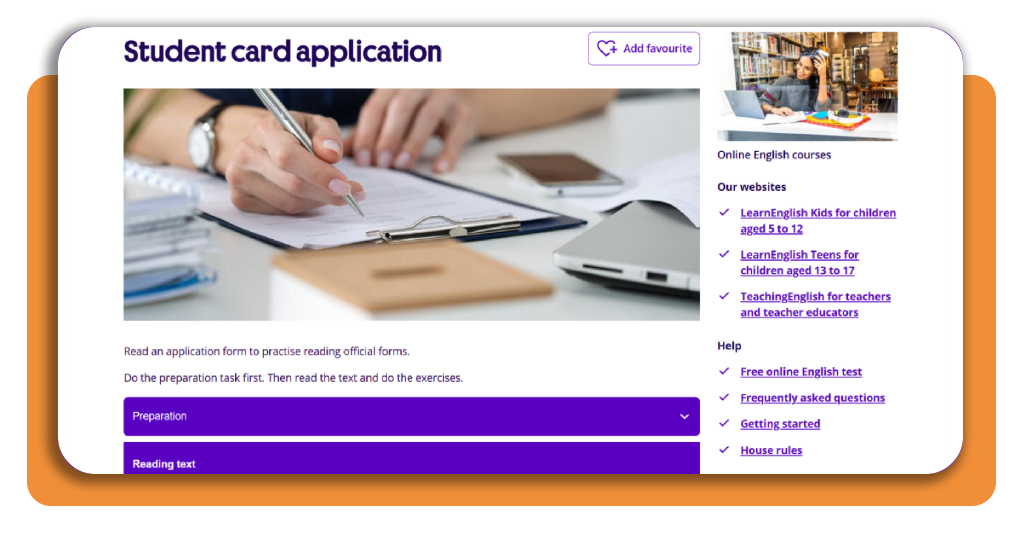
Step 2: warm up with the preparation task
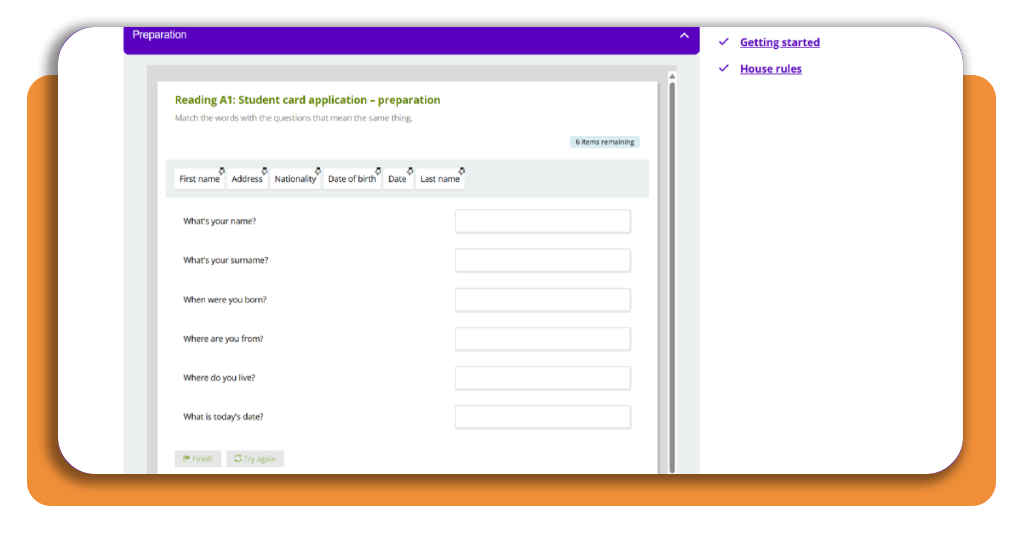
Click the ‘Preparation’ bar to expand it, then drag six labels like ‘First name’ and ‘Nationality’ onto questions that share their meaning, matching ‘Where do you live’ with ‘Address’.
Press ‘Finish’ to check your score and pick ‘Try again’ for any miss, as pairing plain questions with formal labels trains the everyday reading skills that forms demand.
Step 3: read and answer each form field carefully
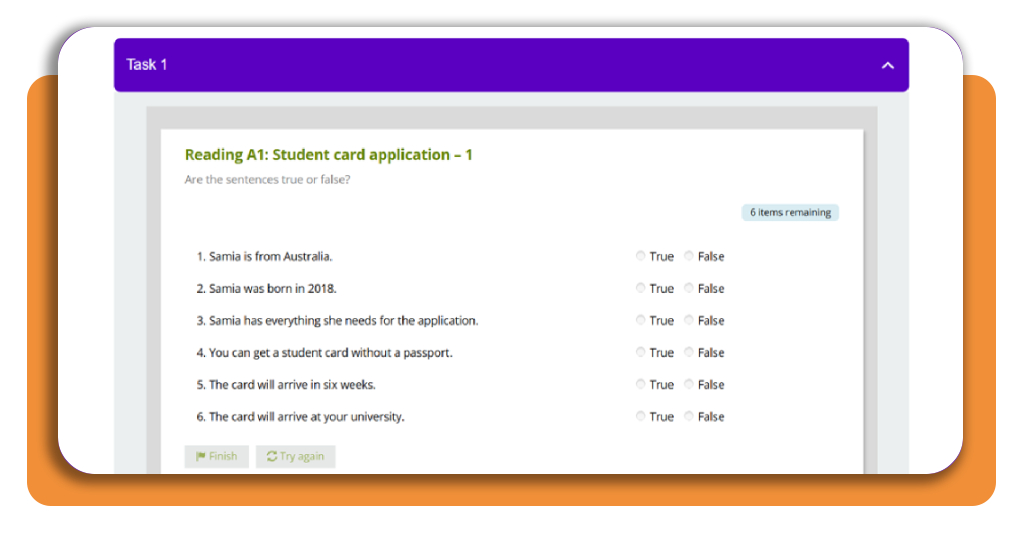
Read Samia’s form from top to bottom, including the checklist and the bold note under it, then open ‘Task 1’ and mark six statements about her as ‘True’ or ‘False’.
Move on to ‘Task 2’ and drag word chunks into the boxes to rebuild four sentences, using the arrows to switch between them until the last dot lights up.
Use comprehension tasks to review key information
After you finish a first pass through the tasks on LearnEnglish, the review tools show you which details from Samia’s form stayed with you and which slid past.
Revisiting a wrong pick sends you back to the line on Samia’s form that tripped you, and the habit trains everyday reading skills like checking dates and deadlines twice.
Below the tasks, the lesson page adds a downloadable worksheet and a discussion question, giving you two more ways to revisit the material away from the drag and drop boxes.
Answer checks that reveal where you slipped
After you submit a task, two buttons appear beside ‘Try again’, with ‘Show answers’ revealing the correct picks and ‘Show feedback’ marking your right and wrong choices in color.
Try ‘Show feedback’ before ‘Show answers’, as seeing which choices missed lets you hunt down the right line on Samia’s form yourself while the solution stays hidden.
A printable worksheet for offline review
Under the ‘Download’ heading, tap ‘Worksheet’ to open a small PDF of the lesson that you can save to your phone or print for a pen and paper session.
Working on paper lets you circle labels, underline the date, and scribble notes in the margins, and the printout keeps the activity handy on a commute or lunch break.
A discussion prompt that puts your reading to use
At the bottom of the page, a discussion question asks about the last application form you filled out, and the replies below it give you extra short texts to read.
Thinking through your answer, maybe a job or bank application, links the lesson to your own life and stretches everyday reading skills without sharing any personal details online.
Where to access free A1 reading lessons
Twelve A1 lessons wait on the LearnEnglish reading page, and the ‘Try another reading’ link under Samia’s activity brings you back to that list when you want a fresh text.
Beyond forms, the list mixes in a restaurant menu, business cards, holiday home adverts, job adverts, and dictionary definitions, giving you variety whenever one topic starts to feel stale.
Messages, notices, and schedules make up the rest, and working through them in any order spreads everyday reading skills across the texts you’ll meet at work and on trips.
Short messages and notes from work
Notes at work hands you four office messages, from a missed call to a reminder about locking the doors, and asks you to pick out names, times, and places.
Text messages to a friend swaps the office tone for a casual chat between two friends, giving you practice with the quick, informal style that fills your phone.
Posters and notices for daily life
A poster at work invites you to an office event, and reading it trains you to find the date, the time, and the place without wading through the rest.
A poster for exam candidates hangs outside a test room, listing the dos and don’ts you’d want to read before you walk in, find your desk, and sit down.
Timetables and schedules for planning ahead
A study timetable lays out a week at a summer school in England, and you practice matching days and times to the activities filling each slot on the plan.
The airport departures board lesson has you scan flight numbers, destinations, and gates, which builds the everyday reading skills you’ll lean on before you board at a busy terminal.
Keep practicing and explore guided English learning
LearnEnglish stretches past reading, with free beginner sections for listening, writing, speaking, grammar, and vocabulary that let you use the words you met on Samia’s form.
The General English area adds a story zone, audio and video series, and a learning hub with community events, giving you fresh ways to keep English in your week.
Progress depends on how often you practice and where you start, and pairing short lessons with listening keeps everyday reading skills tied to the sounds of the words.
Move up to A2 reading practice
Once the A1 texts feel easy, A2 reading brings longer material like emails, invitations, signs, and study tips, with topics you’d run into in a normal work week.
Lessons like ‘An invitation to a job interview’ and ‘An end-of-term report’ push you to dig dates, names, and instructions out of paragraphs that carry more detail.
Test your English level for free
The free online level test places you on the CEFR scale, from A1 Elementary up to C2 Proficiency, and the site has a page describing what each level means.
Taking it before you pick lessons keeps you from drilling texts that feel too easy, and your result points the everyday reading skills you’re building toward the right level.
Optional paid courses and personal tutoring
If you’d like a teacher in the loop, the British Council sells live group classes, private tutoring, and an independent study course, and those carry their own fees.
Check the course page for current pricing and schedules in your time zone before you sign up, and skip it if the free material already covers what you need.
Turn blank form fields into familiar ground
Forms at a bank or clinic can make your stomach drop, and practicing with LearnEnglish samples on your couch eases that pressure before a real form lands in your hands.
In this guide, we explained how to open the student card lesson, read its sample application, check your answers, and browse A1 texts to keep your everyday reading skills moving.
If you’d like to read more articles about improving your reading skills, stay with Insiderbits for tricks that turn confusing letters, bills, and labels into something you can handle on your own.