

Sorting through a loved one’s belongings may leave you wondering whether a forgotten policy is out there. A free life insurance finder can check insurers on your behalf and settle that question.
In this guide, Insiderbits explores the NAIC Life Insurance Policy Locator Service, from the short online form to the unclaimed benefits that could be headed your way. Keep reading!
Which is the best life insurance finder tool for beginners?
When a loved one passes away, the National Association of Insurance Commissioners, or NAIC, gives you its Life Insurance Policy Locator to check whether benefits are waiting for you.
After you submit the form, this life insurance finder stores your request in an encrypted database that insurers open through a secure portal to compare it against their own records.
You don’t need a policy number or an insurer’s name to begin searching, and that makes the NAIC locator the best starting point if you’ve never looked for lost coverage.
One free NAIC request reaches many insurers
The NAIC provides the request form at no cost, and participating insurers shouldn’t bill you for checking their records, with no limit on how many requests you choose to submit.
One request per deceased person covers all participating life insurance and annuity companies, whether your loved one lived in Ohio or Oregon and whether you live in Texas or Maine.
Policies and annuities the locator covers
Policies and annuity contracts both fall within what this life insurance finder searches for, and insurers look for either one under the name of the deceased person that you entered.
The form only accepts requests for a person who has passed away, and the NAIC asks you not to use the service to look for coverage on a living relative.
Limits of the NAIC locator to keep in mind
Insurers take part on a voluntary basis, and a company that hasn’t signed up never sees your request, leaving you to contact that carrier yourself if you know its name.
You can’t check the status of a request after you submit it, and a company contacts you only when it finds a match, which is a process that can take several months.
Step-by-step: how to search for policies using the NAIC
An official death certificate holds most of the details the form asks for, and the funeral home or the deceased’s county or state vital statistics office can issue a copy.
Call your loved one’s employer about group coverage and look through bank statements and safe deposit boxes, a routine that often turns up a policy and spares you the form.
Once those details are in hand, open NAIC’s life insurance finder on a phone or computer and keep your email address within reach, as the form requires one to submit.
Step 1: access the NAIC website
Type NAIC Life Insurance Policy Locator Service into your browser’s search bar, then confirm the web address ends in dot org and shows the NAIC name before you click it.
Open the FAQ link for answers on who can submit a request and what details insurers need, then press the ‘Next’ button when you’re ready to reach the agreement screen.
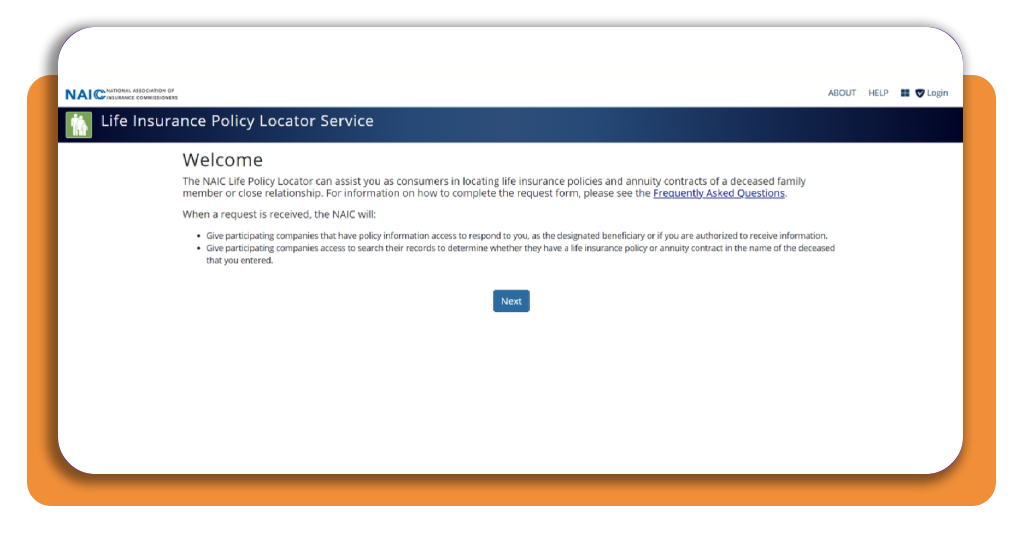
Step 2: agree to terms and add your details
Ask close relatives what coverage your loved one may have held, then click ‘Agree’ on NAIC’s life insurance finder to confirm your details are complete and accurate to your knowledge.
On the contact information screen, fill in every field marked with a red stripe, and skip the middle initial, suffix, and second address line unless they apply, then click ‘Next’.
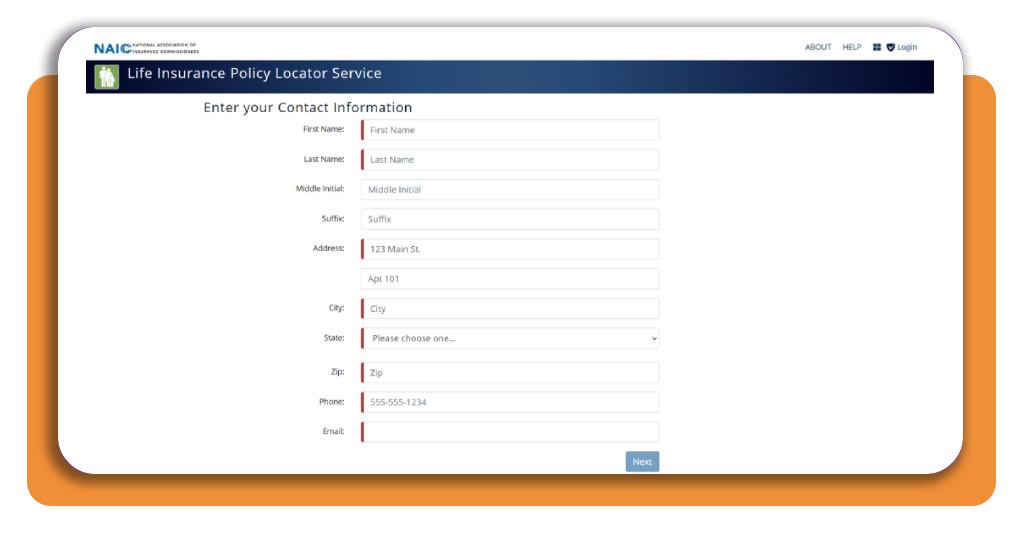
Step 3: enter the deceased’s information and submit
Enter the deceased person’s Social Security or ITIN number, birth and death dates, legal name, veteran status, and relationship to you, plus the middle initial and suffix when they apply.
Click ‘Submit’ once every required field is complete, then watch your inbox and spam folder for a confidential email from the NAIC that repeats all the request details you entered.
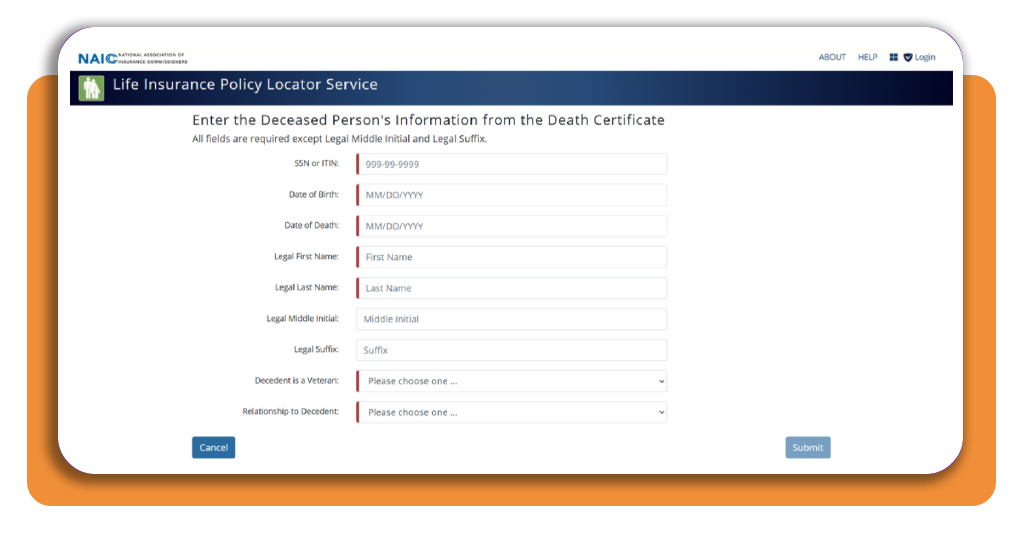
Requirements for requesting payment of the amount
Finding a policy and collecting its money are two separate tasks, and the second one depends on showing that you have the right to claim a payout the insurer holds.
Once the request goes out through this life insurance finder, the NAIC steps back, and the company that holds the policy decides on your claim under its own claim rules.
Companies set their own requirements, and the list you face can shift from one insurer to the next, with the reply you receive stating what that company wants from you.
Necessary documents and criteria
Insurers answer only when you’re the designated beneficiary or hold legal authority to act for the deceased, and you’ll want to check where you stand before you expect a reply.
An insurer may also ask for a notarized death certificate, proof of your legal authority, and its own claim form, and you’ll want copies ready before a company reaches out.
What to expect after a match is found
A match through this life insurance finder doesn’t guarantee a payout, as the insurer reviews your claim and the documents you send before it decides whether to release the money.
Fill out the claim form the company sends, return it with the requested documents, answer any extra requests the insurer makes, and keep a copy of every page you submit.
Get help from your state insurance department
Every state runs an insurance department that you can contact by phone or email when an insurer’s reply stalls or a company’s requirements leave you confused about your next move.
For trouble with the request form itself, email the NAIC help desk, and turn to your state department for questions about how a specific company handles your claim.
Top national life insurance carriers
A statement or letter from a large national carrier can be the first sign of a forgotten policy, and knowing what these companies sell helps you make sense of it.
Whether you’re tracing a policy with the life insurance finder or shopping for coverage of your own, these carriers show you the range of products that large national insurers offer.
Details such as products, ages, and coverage limits change, and the carrier’s own site holds the final word on what you can buy, qualify for, or claim from the company.
MetLife group coverage and beneficiary support
MetLife offers ‘Term Life’ along with group universal life, accidental death and dismemberment plans, and many of these options come through an employer’s benefits program.
Its site lists beneficiary assistance, a ‘Find an Insurance Policy’ page, an unclaimed property claim, and a ‘Life Needs Calculator’ to help you gauge how much coverage your family needs.
Equitable term and universal life options
Equitable lets you update beneficiaries online, and keeping a current name on file spares your loved ones from needing a search through NAIC’s life insurance finder to find your coverage.
Term plans run 10, 15, or 20 years, with a 10-year no-exam option for ages 18 to 60, plus a 0% floor indexed universal life and variable universal life.
Prudential term and final expense coverage
Prudential offers convertible term policies of 10 to 30 years with a free accelerated death benefit rider, plus universal life, variable universal life with survivorship, and indexed options.
Its final expense policy covers applicants ages 50 to 85 with $5,000 to $30,000 in coverage, and quotes come by phone at 800-778-2255 while claims and beneficiary changes happen online.
One free form could find a forgotten policy
A policy your loved one never mentioned may still be waiting for your family, and one free online request to the NAIC could track it down for you.
In this article, Insiderbits explained how to search with this life insurance finder, gather the papers an insurer asks for, and find help from your state department.
Keep reading Insiderbits for guides on life insurance and other important policies, and you’ll learn what you own, what it covers, and how to make it pay off.
Frequently Asked Questions
Is the NAIC Life Insurance Policy Locator free to use?
Yes. The NAIC provides the request form at no cost, and participating insurers should not bill you for checking their records. There is also no limit on how many requests you choose to submit.
Do I need a policy number to search for a lost life insurance policy?
No. You don’t need a policy number or an insurer’s name to begin searching. The NAIC locator is designed to work even when you have minimal information about the policy.
How long does it take to get a response after submitting a request?
A company contacts you only when it finds a match, and that process can take several months. You cannot check the status of a request after you submit it, so monitor your inbox and spam folder regularly.
What documents do I need to claim a found life insurance policy?
Requirements vary by insurer, but you should generally have a notarized death certificate, proof of your legal authority to act for the deceased, and the insurer’s own claim form. Being a designated beneficiary is typically required to receive a payout.
What if an insurer is not participating in the NAIC locator?
Insurers take part on a voluntary basis. If a company hasn’t signed up, it will never see your request. In that case, you’ll need to contact that carrier directly if you know its name.
Can I use the NAIC locator to search for a policy on a living person?
No. The form only accepts requests for a person who has already passed away. The NAIC explicitly asks you not to use the service to look for coverage on a living relative.