Asking friends to repeat themselves and nudging the TV volume higher at night could point to changes worth checking. A quick test on your phone reveals where your hearing health stands.
In this article, Insiderbits shows how the Hearing Test app turns your phone into a pocket audiogram, then steers you toward OTC hearing aids and habits that keep your ears in check.

4.7/5
What is the best app for a hearing health scan?
Hearing Test (Android) is an audiometry app built by an audiology developer in Poland, and it plays tones through your headphones to find the softest sounds your ears can pick up.
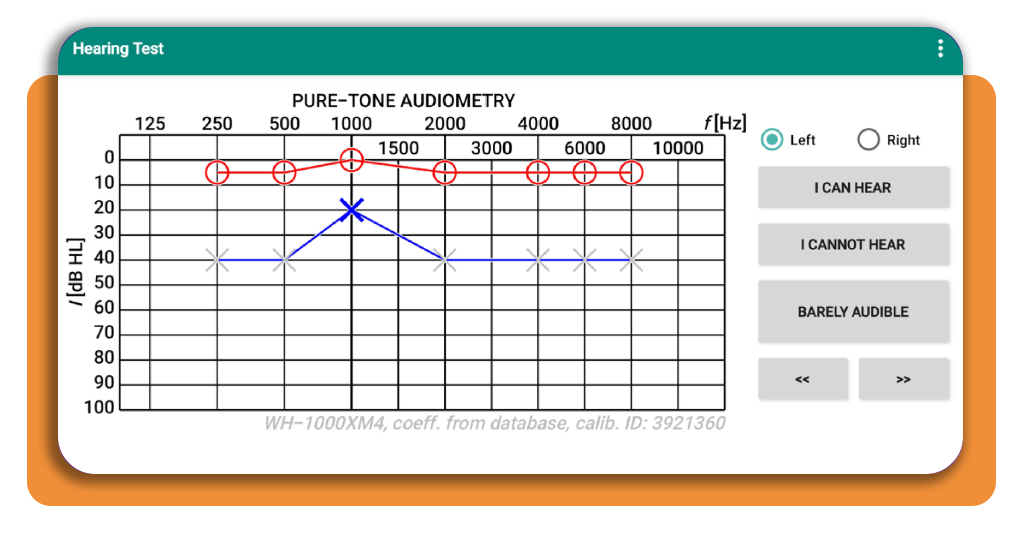
Your results appear on an audiogram, a simple grid that maps your hearing health across low and high pitches on the same decibel scale audiologists apply to their own patients.
The developer presents it as an informational tool rather than a medical replacement, and its results help you judge whether OTC hearing aids or a specialist appointment fits your situation.
Key features within the Hearing Test app
- Headphone calibration database: pick wired or Bluetooth headphones, and the app pulls matching coefficients, or a person with normal hearing can calibrate other models;
- Background noise meter: your phone’s microphone measures room sound while you test, helping you choose a quiet spot where a humming fridge won’t skew results;
- High-frequency audiometry: testing extends to shrill pitches reaching 10,000 Hz, the upper range where damage from loud concerts and blasting earbuds tends to surface;
- Notes and printable results: jot comments on any test, print your audiogram for a doctor, and fine-tune levels with readings from a clinical audiometer.
Test your speech clarity in background noise
The digits in the noise test play groups of three spoken numbers over a layer of background sound, and you tap in what you heard on a keypad that appears onscreen.
Struggling with those triplets can flag trouble in crowded restaurants, and that insight rounds out your hearing health picture with a detail the beeps of a tone test can’t capture.
Compare your results with age-based hearing norms
Once your audiogram fills in, the app sorts your results into shaded bands ranging from normal hearing to severe loss and lays them beside typical thresholds for your age bracket.
If you’re 30 and your thresholds resemble those of someone twice your age, the gap tells you to rethink your volume habits and start comparing a few OTC hearing aids.
Step-by-step: how to test your hearing accuracy at home
Hearing Test (Android) needs a quiet room and a decent pair of headphones to give you reliable results, and a charged phone keeps the test from shutting down before you finish.
Before starting, turn on “Do Not Disturb” and mute fans or TVs nearby, giving your hearing health readings a calm environment where buzzing phone alerts can’t throw off a result.
Rushing through faint tones invites guesswork, and settling into a comfortable chair with your phone in hand lets you respond to sounds your ears catch rather than ones you expect.
Step 1: download Hearing Test on your phone
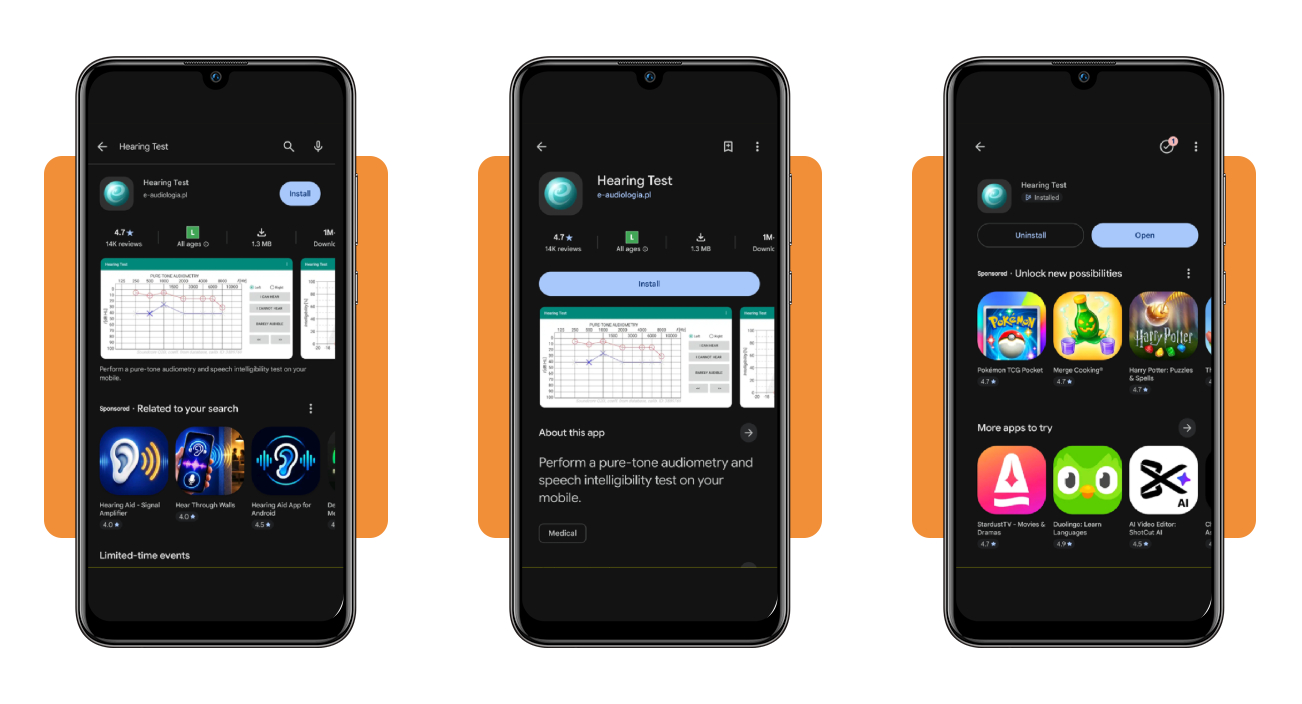
Open the Google Play Store on your Android phone, search for “Hearing Test”, and pick the listing offering pure tone audiometry before tapping “Install” and letting the app download finish.
Launching it for the first time pops up a short legal disclaimer about anonymous data collection, and tapping “OK” confirms you’re an adult who agrees to take the hearing test.
Step 2: choose your test and headphones
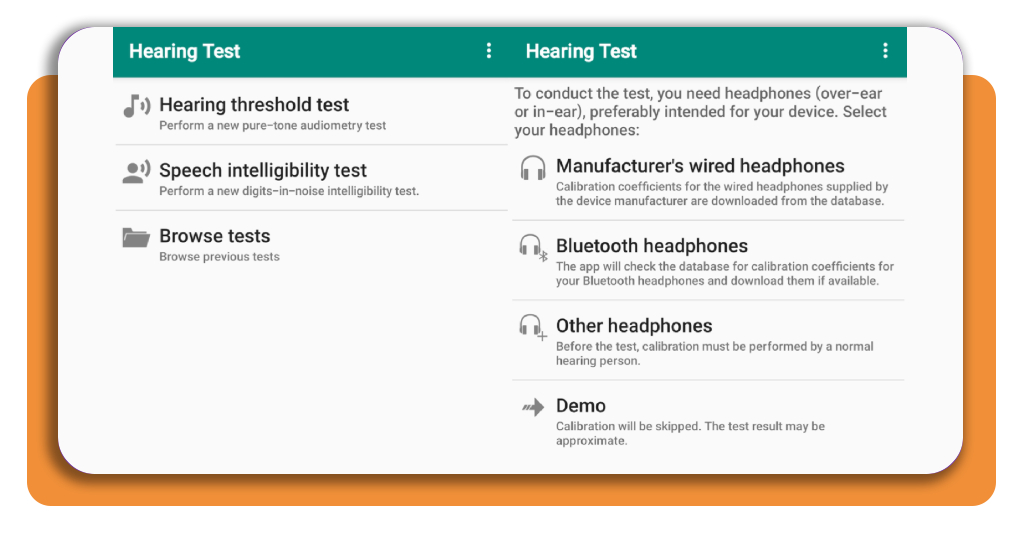
Tap “Hearing threshold test” on the app’s home screen for a pure tone audiometry session, or choose the “Speech intelligibility test” if following conversations in loud places worries you more.
The next screen asks about your headphones, and picking the wired, Bluetooth, or one that matches your pair beats Demo mode, which is a shortcut that skips calibration and blurs results.
Step 3: track each ear and read your audiogram
Pick “Left or Right”, press “I can hear” or “I cannot hear” until the tone fades to its faintest audible point, then lock that level in by tapping “Barely audible”.
Tap the forward arrows to cycle through frequencies, and your finished audiogram plots your hearing health using red circles for the right ear and blue crosses for the left one.
How to prevent hearing loss
Noise harms your ears through two factors working together: the loudness of a sound and the amount of time you spend exposed to it during a concert or work shift.
Your own voice works as a handy gauge, and needing to shout for a friend an arm’s length away to hear you signals noise loud enough to cause lasting damage.
No medicine or surgery can undo damage from loud sound, and if you suspect a problem, booking a doctor visit and protecting your ears keeps your hearing health from slipping.
Keep your playlist volume in check
Earbuds deliver music into your ear canal, and lowering your phone’s volume a few notches protects the hair cells your inner ear relies on to pick up sound and speech.
Setting a listening limit in your sound settings caps how loud music can go, and noise-canceling headphones block the subway rumble that tempts you to crank up the dial.
Give your ears regular breaks from noise
Stepping onto the patio of a loud bar or drifting away from the speaker stack at a party shrinks the noise dose your ears absorb from music and crowd chatter.
Chores like mowing the lawn or running a leaf blower deserve the same treatment, and splitting them into shorter sessions with quiet stretches in between keeps the exposure manageable.
Pack earplugs for concerts and loud events
Foam earplugs squish and expand to fill your ear canal, while reusable silicone sets and molds from an audiologist give you a snug seal without muffling your favorite band onstage.
Earmuffs slide over your head and suit fireworks, live concerts, or woodworking projects, and stashing a pair in your car protects your hearing health wherever the decibels spike.
Top OTC hearing aid brands
OTC hearing aids land on store shelves and websites without a prescription, and they’re built for mild to moderate loss, the range your audiogram needs to show before you buy.
Audiologists at HearAdvisor program dozens of OTC models in their lab for the same hearing profile and score them on speech, music streaming, feedback, and how your own voice sounds.
Only 10 of 37 models score 4.0 or higher and earn the lab’s Expert Choice award, and the standouts among them suit different budgets, ear styles, and hearing health goals.
Yeasound RIC800 for crisp everyday sound
The Yeasound RIC800 places a tiny speaker inside your ear canal while the main body tucks behind your ear, and it shines with voices in quiet rooms and music you stream.
Its platform puts volume, listening programs, an equalizer, and directional microphone settings on your phone, and the $659 price tag covers a pair that keeps feedback whistles in check.
Audicus Omni 2 for premium all-around performance
Audicus Omni 2 wraps behind your ear and prioritizes understandable speech with feedback control, giving you dependable sound at quiet dinners, meetings, and family gatherings.
Expect to pay $1,897.96 for both aids, which makes sense if your hearing health tops your spending priorities and you want performance without booking appointments with audiologists.
Elehear Delight for first-timers on a budget
The Elehear Delight rests inside your ear with a small visible shell, and its simple setup suits you if hearing aids feel brand new and you’d rather skip complicated app menus.
At $315 a pair, it costs less than half the RIC800’s price, and its default settings make kitchen table conversations easy to follow without any fine-tuning on your end.
4.7/5
Catch the quiet sounds before they slip away
With Hearing Test (Android) on your phone and a pair of headphones, you can settle whether your family mumbles or your ears need help, and that answer determines what you do next.
In this article, you discovered a phone test for your ears, OTC aids for different budgets, and simple habits that protect your hearing health during concerts, yard work, and commutes.
Keep reading Insiderbits for health and wellbeing ideas you can try at home, like better sleep routines and calmer mornings, plus handy apps that save you money and doctor trips.