

Unclaimed inheritance may include money or other assets that heirs haven’t received. Depending on state law and the type of asset, unclaimed funds may be transferred to a state unclaimed property program.
Searching official government databases can help you find potential family assets, verify your eligibility, and begin the claims process without paying third-party services. Read on Insiderbits.

4.5/5
Which is the best app to search for unclaimed family inheritance and missing assets?
Unclaimed inheritance and other forgotten assets can include dormant bank accounts, uncashed dividend checks, trust distributions, safe deposit box contents, and unpaid life insurance benefits.
When a relative passes away without leaving clear financial records or heirs move without updating their contact information, these assets can go unnoticed.
Searching multiple state treasury websites and government databases can make tracking down missing family property a challenge.
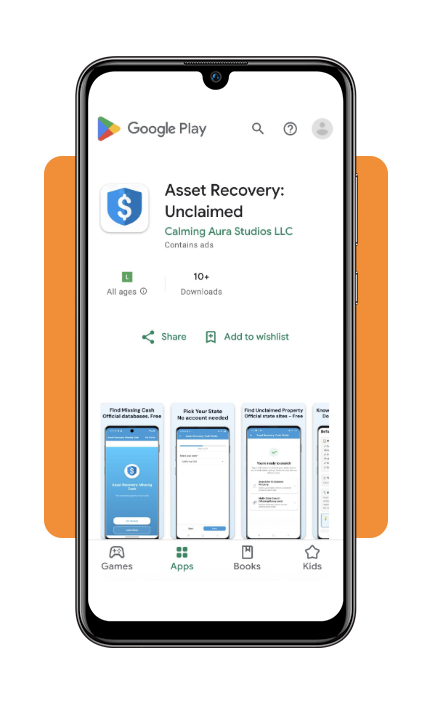
The Asset Recovery app (iOS | Android), developed by Calming Aura Studios, helps simplify the process by organizing official database links, creating search checklists, and directing users to free state treasury portals.
It guides users through the search process rather than charging fees or claiming assets on their behalf. To start looking for unclaimed property on your phone, download the app from the iOS App Store or Google Play.
Key Features within Asset Recovery
The Asset Recovery app (iOS | Android) offers tools to help users search for missing assets and explore potential unclaimed inheritance through a more convenient mobile experience:
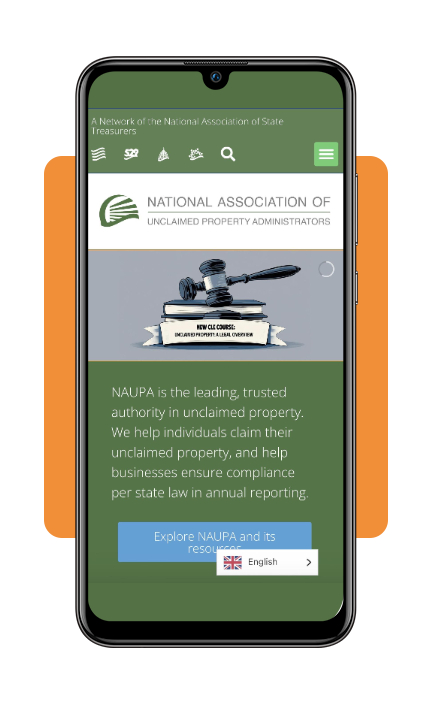
- Official treasury portals directory: direct access to official state unclaimed property search portals across all 50 states via official government and National Association of Unclaimed Property Administrators (NAUPA) directories;
- Custom search prep checklists: generates tailored intake checklists based on your specific state, outlining exactly what documentation (such as SSNs, past addresses, and maiden names) you need before initiating searches;
- Multi-state lookup guidance: prompts users to check every state where a deceased relative lived, worked, or operated a business, ensuring no regional account is overlooked;
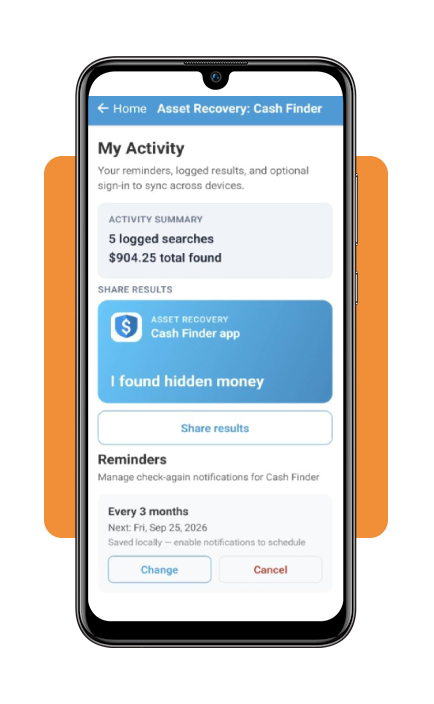
- Private on-device progress tracking: allows heirs to log claim numbers, track filing progress, and store private search notes locally on their device without transmitting sensitive financial data to third-party servers.
Step-by-step: how to search and claim lost family property
Finding an unclaimed inheritance can take some research, especially if a deceased relative lived in several states. Follow these steps to search for potential family assets and learn how to claim funds you’re entitled to receive.
Step 1: install the mobile application
Visit the Asset Recovery iOS App Store page if you use an iPhone, or open the Asset Recovery Google Play Store page if you use an Android device, and download the app to your device.
Open the app and review its built-in search preparation guides.
Gather complete details for your deceased or living relatives—including full legal names, historical residential addresses, previous employer names, and Social Security Numbers.
Step 2: access official state and national portals
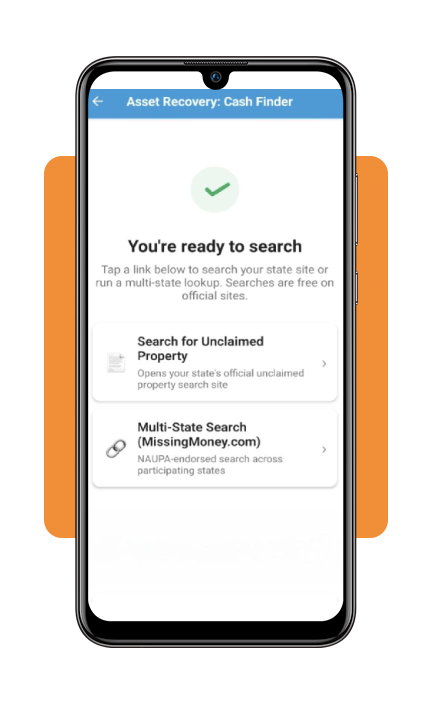
Use the app’s directory to navigate directly to official state unclaimed property websites (such as Unclaimed.org and MissingMoney.com) for every state where your family members lived or owned property.
Step 3: execute regional searches
Input your family members’ names into the official treasury search fields. Check multiple spelling variations, middle names, and historical maiden names to catch dormant accounts or uncashed checks.
Step 4: track claims and manage documentation
When a property match appears, use the app’s tracking tools to log your claim numbers, record submission dates, and organize your proof of kinship documents (death certificates and probate paperwork) for state review.
Top national estate planning attorneys
Claiming unclaimed inheritance can become more complicated when an estate involves contested wills, large trust distributions, or probate proceedings across multiple states.
In these situations, an estate planning attorney or inheritance lawyer can help clarify your rights, navigate legal requirements, and guide you through the claims process.
The American College of Trust and Estate Counsel (ACTEC)
ACTEC is a peer-elected national association of prominent trust and estate attorneys.
Their professional directory allows families to locate vetted estate litigation specialists qualified to navigate complex inheritance disputes, fiduciary accounting, and multi-million-dollar asset claims.
National Estate Planning Law Firms (e.g., ACTEC Fellows & Regional Specialists)
Regional law firms specializing in probate can help out-of-state heirs navigate ancillary probate proceedings and file petitions to establish legal heirship.
They can also assist with obtaining certified letters of administration, which state treasuries may require to release unclaimed assets.
Legal Services Directories (ABA & State Bar Referral Services)
State bar associations maintain public referral networks that connect claimants with licensed probate attorneys.
Many offer reduced-fee initial consultations to review estate documentation and determine whether formal probate court representation is necessary to unlock high-value unclaimed assets.
Best options for submitting legal proof of kinship
State unclaimed property administrators enforce strict verification guidelines before releasing funds belonging to a deceased owner.
Submitting complete, legally valid proof of kinship prevents claim rejections or long processing delays:
- Certified copies of death certificates: state treasuries require an official, raised-seal death certificate issued by the vital statistics department of the state where the relative passed away;
- Probate court letters testamentary or letters of administration: for formal estates, court-issued documents naming an executor or personal representative serve as primary legal proof authorizing an individual to collect property on behalf of the estate;
- Small estate affidavits and affidavits of heirship: if the deceased relative’s estate was small and did not go through formal probate, most states allow rightful heirs to submit a notarized Small Estate Affidavit alongside proof of kinship (such as birth and marriage certificates linking the claimant to the deceased);
- Government photo identification and SSN proof: claimants must verify their own identity by providing a copy of a driver’s license, passport, and official proof of Social Security Number (such as a W-2, 1099, or Social Security card).
When tracking down distant relatives to establish inheritance rights, a genealogy app can help you map out family branches, verify historical marriage records, and document legal lines of descent.
4.5/5
Finding and claiming inherited assets
Finding an unclaimed inheritance can help you recover assets that may belong to you or your family.
Start by searching free official databases, such as Unclaimed.org, and gather any documents needed to establish your legal right to the property.
If the claim involves a complex estate, an inheritance attorney can help you understand the requirements and navigate the process.