

A forgotten paycheck from an old job could cover next month’s rent and groceries, and the federal government may be holding unpaid wages with your name on them, waiting for a claim.
In this guide, Insiderbits covers Workers Owed Wages, the Labor Department tool that could send back pay from a past employer into your bank account, plus the steps to claim it. Read on!
Which is the best official platform to check unpaid wages?
Workers Owed Wages is a searchable federal database where you can look up any back pay that investigators collected from employers on behalf of workers they couldn’t locate.
Each record ties a worker’s name to an employer, and a match on your name in the results lets you submit a claim for the money waiting there.
If a past employer shorted your overtime or skipped a final paycheck, a quick search could reveal whether unpaid wages recovered from that company belong to you.
Key features within Workers Owed Wages
- Keyword search: type your employer’s name or industry words like drywall, then add an optional state filter to trim lists of similar company names;
- Sortable grid: results list company and legal names, addresses, cities, and states, and you can sort four of those columns to spot your employer;
- Name matching: enter your first and last name, and the tool lists every version of it found for that employer for you to select;
- Spanish version: a small corner button switches the page to Spanish, and a Need Assistance link greets you in the footer of every screen.
Understand the three-year Treasury deadline
The government holds the money while it searches for you, and after three years without a match, rules require it to send the funds to the US Treasury.
Search employers from your latest jobs first and check older ones next, though funds tied to cases from those earlier years may have already been moved.
Backed directly by the Department of Labor
The Wage and Hour Division of the US Department of Labor investigates pay violations and recovers unpaid wages, and every listing you see links to a real case.
If a search comes up empty, you can call 1-866-4-USWAGE (1-866-487-9243) to reach a local Wage and Hour office, where staff can tell you about money that may await you.
Step-by-step: how to search government records for back pay
Searching Workers Owed Wages for back pay works like a short online form, where each screen narrows the database down from every employer on file to your work history.
Before you begin, dig out an old pay stub or W-2 to confirm your employer’s legal name, and have a current email address ready for the last screens.
Each completed step gives the agency the details it needs to connect you with unpaid wages owed by a past employer and to reach you about the payout.
Step 1: access the official website
Search for Workers Owed Wages in your browser and pick the result from the Department of Labor with a .gov address to land on the official page.
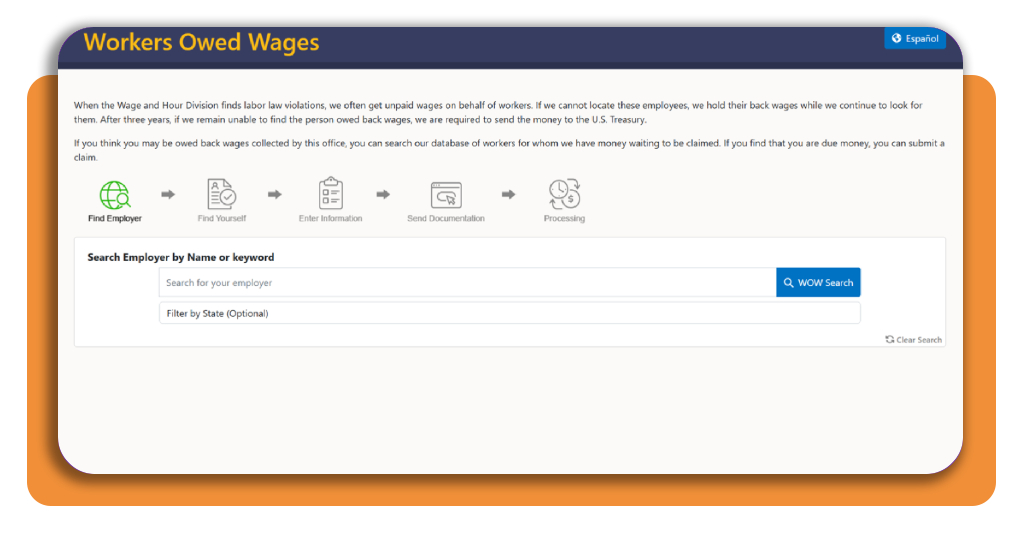
The page opens with a short introduction and a tracker of five icons, and the green Find Employer icon marks where the search box for your employer waits.
Step 2: search for your employer
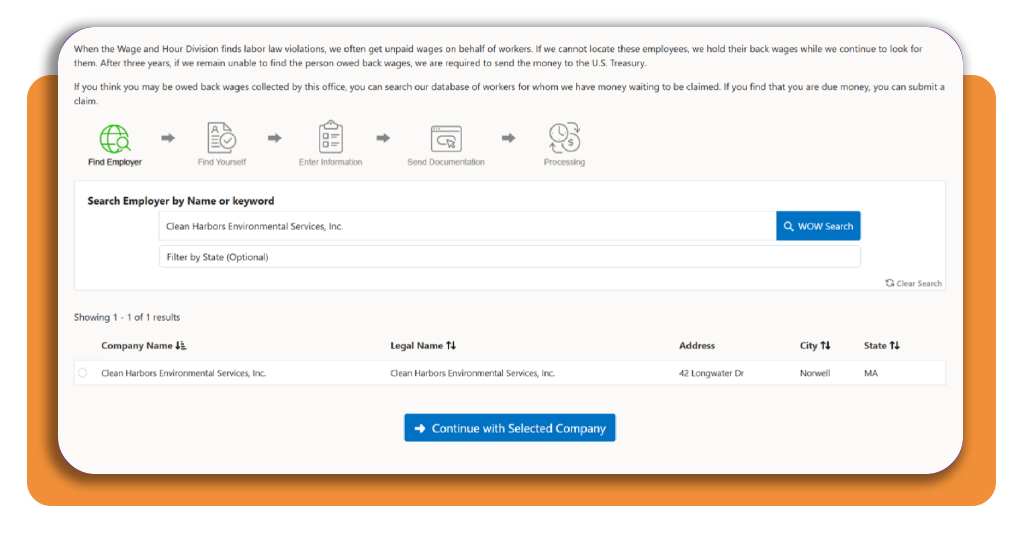
Enter your company name and trim any long legal name to fit the 3 to 45 character limit, then click the blue ‘WOW Search’ button to see results.
Scroll the results, use ‘Next’ to page through them, select the circle beside your employer, then press ‘Continue with Selected Company’, or reword your search if nothing matches.
Step 3: check your name in the results
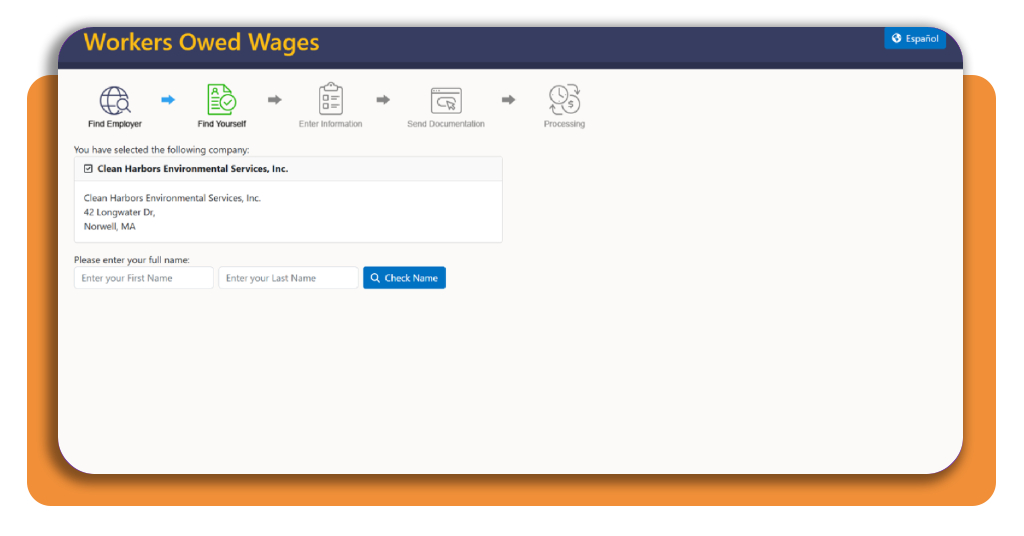
Type your first and last name into the two boxes beneath the selected company card, then click ‘Check Name’ and wait for the site to display any matches.
If your name appears, select it and press ‘Continue’ to start a claim for unpaid wages, or click ‘Begin again’ with a new search to test another spelling.
Step 4: enter your contact details and submit
Fill in every contact field with accurate details, then click the ‘Submit’ button to open a summary page that lists the company alongside the employee information you entered.
Fix mistakes with ‘Edit Information’, then click ‘Submit Information’ to reach the final page, and watch your inbox for a confirmation number, the claim form, and return instructions.
Top employee rights organizations
Nonprofit worker centers cover ground that a federal database can’t reach, offering education and legal advocacy that reflect the local neighborhoods and industries where you work.
Government records include only cases where investigators recovered money, which makes a nonprofit a useful contact when you face unpaid wages that no investigator has ever recorded.
A national list of 13 nonprofits for workers’ rights includes 3 that focus on wages and job conditions, and each serves a community that may match your own.
Fe y Justicia fights for Houston’s low-wage workers
Fe y Justicia Worker Center treats a safe, healthy workplace as an expectation and pushes to raise wages, benefits, and conditions for people in low-paying jobs around Houston.
Its organizers bring workers together to press for changes on the job and pull neighbors and congregations into the fight over workers’ rights issues that shape local paychecks.
Center for Workers Rights backs Sacramento’s vulnerable workers
The Center for Workers Rights advocates for vulnerable employees, including caregivers, pregnant workers, undocumented immigrants, survivors of domestic violence, and more.
Its mission calls for workplaces where employers treat workers with dignity, a standard that applies when a boss withholds unpaid wages or punishes workers for raising the issue.
Mississippi Workers Center offers legal advocacy and training
The Mississippi Workers Center for Human Rights provides legal advocacy for Black workers in low-paying jobs, and it presses employers to improve their job conditions.
Through training, the center prepares workers to claim their rights and pushes for equal access to good jobs and humane living conditions regardless of race, gender, or faith.
Best options for filing wage theft complaints
Wage theft includes skipped pay, denied overtime, hourly rates below the legal minimum, illegal deductions, and a false contractor label that hides your true status as an employee.
Pay stubs, schedules, time records, and messages from your manager support a claim for unpaid wages, and a personal daily log of your hours can fill any gaps.
If it feels safe, raise the issue with your manager or HR and note the replies, which can settle honest mistakes and create a record when talks fail.
Start with your state labor board
Your state labor department may handle wage claims under its own rules, and a quick look at its website tells you which forms and strict filing deadlines apply.
The claim form asks about the employer, the job, and the amount owed, and depending on your state, you can submit it online, by mail, or in person.
Go federal with the Wage and Hour Division
Turn to the Wage and Hour Division when your state has no labor department that handles wage claims, and expect the same complaint details a state board requests.
Investigators may interview you and your employer, review records, or request additional documents, and a violation can leave the employer owing unpaid wages and damages.
Bring in a wage theft attorney
Consider an attorney when an agency denies your claim or an employer refuses to pay, and many lawyers offer free consultations and collect fees only if you win.
A class action lets coworkers with shared problems sue together, and firing, demotion, harassment, or hour cuts after your complaint are illegal retaliation you can report to authorities.
Your old paycheck may still be waiting
Chasing pay from a past job might feel awkward, but a quick search on Workers Owed Wages and a call to the right office can return the money you’ve worked so hard to earn.
In this guide, Insiderbits explained how an official federal database, local worker groups, and state complaint offices can help you recover the unpaid wages from a past employer.
Stay with Insiderbits for more articles about unclaimed money and other benefits from past jobs, and keep reading to find out what else might be waiting for you.