

When planning for retirement, learning how to compare Social Security payout strategies across different filing ages can mean a difference of hundreds of thousands of dollars over your golden years.
While claiming early at age 62 offers immediate cash flow, delaying until Full Retirement Age or age 70 can significantly increase your monthly check. Read on Insiderbits.

4.2/5
Which is the app to compare Social Security claiming ages and maximize benefits?
Across the United States, millions of workers navigate the tradeoff between receiving smaller benefit checks early or waiting for maximum payouts later.
Taking the time to compare Social Security scenarios helps ensure that your retirement timeline aligns with your health expectations, personal savings, and long-term financial goals.
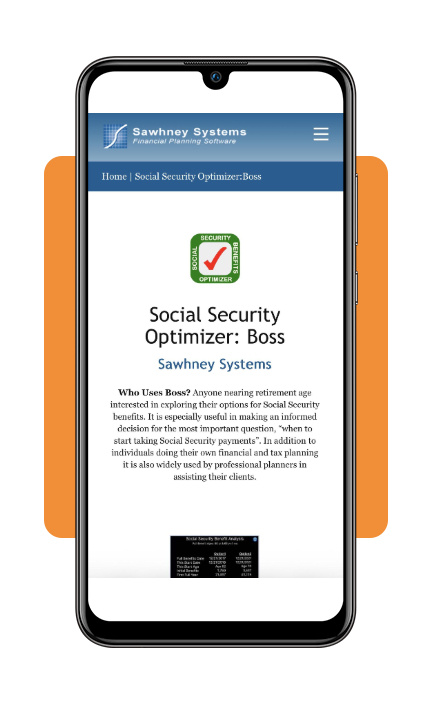
If you want an accessible mobile tool to compare Social Security filing ages on your phone, Social Security Optimizer: Boss (Benefit Optimizer for Social Security) stands out.
Developed by Sawhney Systems, the BOSS app allows individuals and married couples to test various retirement scenarios with minimal initial data.
Available for iOS and Android, by entering your date of birth and your estimated primary insurance amount at full retirement age, you can run interactive projections.
Key features within the Social Security Optimizer platform
- Dual filing support for singles and couples: the platform lets you model standalone individual benefits as well as coordinated joint filing strategies for married couples;
- Side-by-side scenario tools: compare Social Security schedules to determine optimal start dates and maximize combined household distributions;
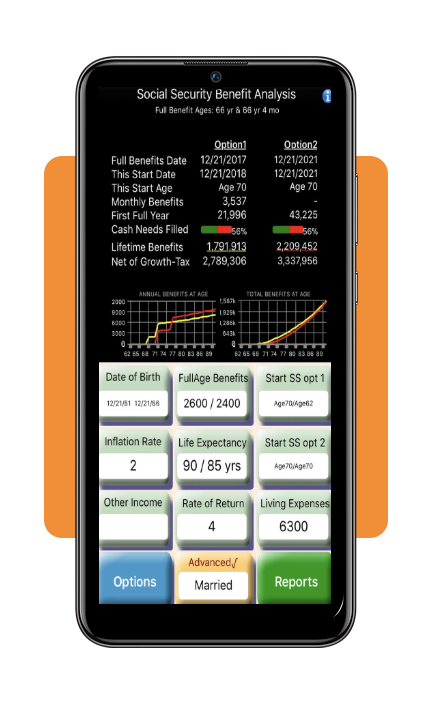
- Interactive break-even visualizations: view clear line graphs and comparative reports showing the exact crossover age where delaying benefits yields higher cumulative lifetime payouts;
- Customizable economic parameters: fine-tune your projections by adjusting assumed annual inflation rates, investment rates of return, tax brackets, and cost-of-living adjustments;
- Cash need fulfillment analysis: evaluate how different claiming ages align with your monthly living expenses and required portfolio withdrawal rates;
- On-device data privacy: your personal financial information stays stored on your local phone without requiring external servers or account creation.
Step-by-step: how to model different claiming ages and calculate your payout
To build a retirement roadmap, you must evaluate how claiming timing alters your long-term wealth trajectory. When you compare Social Security step-by-step, you gain the data needed to choose your filing window:
Step 1: access your official record from ssa.gov
Log into your personal My Social Security account online to obtain your estimated monthly benefit at Full Retirement Age.
This baseline figure (PIA) serves as the benchmark from which all early reductions or delayed credits are calculated.

Step 2: input baseline figures
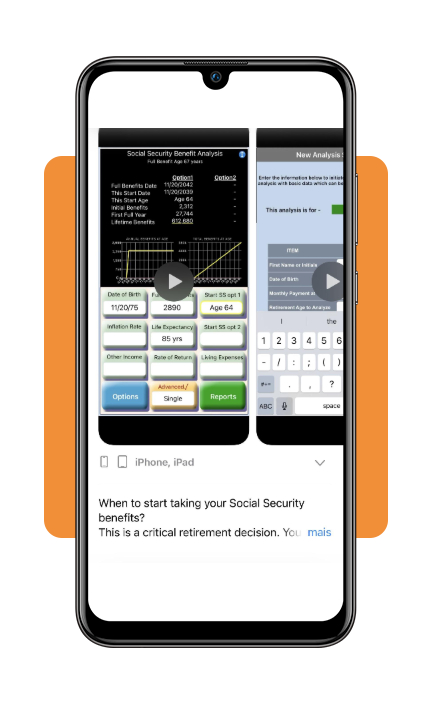
Enter your birth date and PIAs into Social Security Optimizer: Boss.
Input your target claiming ages—such as 62, 67, and 70—to compare Social Security baseline monthly amounts side-by-side in real time.
Step 3: factor in longevity and family history
Your optimal claiming age depends on how long you expect to draw benefits.
Looking into your family health history or using a dedicated genealogy app can help you evaluate ancestral lifespan patterns to establish a realistic longevity horizon.

Step 4: run break-even analysis
Use the app’s (iOS | Android) break-even charts to identify the exact age (typically around ages 77 to 80) where the cumulative cash collected from delaying to age 70 surpasses the earlier checks received starting at age 62.
step 5: integrate tax and inflation variables
Adjust economic sliders for inflation and combined household taxable income to evaluate your net post-tax monthly cash flow under each claiming option.
Understanding FRA, early penalties, delayed credits, and spousal benefits
To compare Social Security options, you must grasp the underlying mechanics governing how monthly checks expand or shrink based on filing age.
Financial data on the average Social Security check by age points out that claiming timing impacts individual monthly allocations.
Full Retirement Age (FRA) baselines
For anyone born in 1960 or later, Full Retirement Age is 67. Claiming at FRA guarantees you receive 100% of your earned Primary Insurance Amount without penalties or bonus credits.
The overall average Social Security monthly check for retired workers sits around $2,084.40, while the maximum possible monthly check for someone retiring at FRA reaches $4,152.
Early claiming penalties (Age 62 to FRA)
You can choose to claim benefits as early as age 62, but doing so imposes a permanent reduction on your monthly payout. Filing at 62 reduces your baseline check by 30% compared to waiting until age 67.
- Age 62 payout reduction: 30% permanent reduction from FRA baseline;
- Age 63 payout reduction: 24% permanent reduction from FRA baseline;
- Age 64 payout reduction: Permanent reduction scaled by months claimed before FRA;
- Maximum benefit at age 62: Caps at $2,969 per month regardless of past high earnings.
Delayed retirement credits (FRA to Age 70)
For every year you delay claiming past your FRA up to age 70, the SSA rewards you with delayed retirement credits. These credits grow your benefit by 8% per year (or 0.66% per month).
- Age 68 benefit growth: 8% increase above FRA baseline;
- Age 69 benefit growth: 16% increase above FRA baseline;
- Age 70 benefit growth: 24% permanent increase above FRA baseline;
- Maximum benefit at age 70: Caps at a massive $5,181 per month.
Spousal benefit calculations
When you compare Social Security strategies as a married couple, spousal rules play a critical role.
A lower-earning spouse can receive up to 50% of the primary earner’s FRA benefit amount if claimed at their own FRA.
However, spousal benefits do not accrue delayed retirement credits past FRA, making age 67 the natural maximum threshold for spousal claims.
Best high-yield savings accounts
If you choose to delay claiming your benefits until age 70 to lock in maximum monthly checks, you may need to draw down cash reserves to cover living expenses between ages 62 and 70.
Stashing your emergency bridge funds in top-tier accounts allows you to earn high interest while keeping liquidity accessible.
Reviewing competitive rates for the best high-yield savings accounts ensures your bridge capital works during the transition years.
Top online high-yield savings features to look for
- High Annual Percentage Yield (APY): top online banks offer yields significantly above national brick-and-mortar averages, maximizing return on cash reserves;
- Zero monthly maintenance fees: leading platforms do not charge monthly service fees or maintain strict minimum balance penalties;
- FDIC insurance coverage: federal insurance protects cash deposits up to $250,000 per depositor, per insured institution;
- Liquidity and easy transfers: look for institutions offering fast electronic transfers so you can draw income during bridge years.
4.2/5
A decision that can shape your retirement
Choosing when to claim Social Security is one of the most important retirement decisions you’ll make.
The timing of your benefits can affect your monthly income for years, making it worthwhile to evaluate your options before filing.