
An Electrician License and a training certificate may serve different purposes. It’s worth checking what your state or local authority requires for the type of work you want to perform.
Most states license electricians, but the rules vary by location and license category. Official state resources show you the required experience, training, exams, fees, and renewal rules.
Electrician license requirements: start with official agencies
The first information you must have is that the electrician license is not handled under one national set of rules.
Many of the requirements can change by state and license category, so the safest starting point is the government agency responsible for licensing where you plan to work.
That agency should show which license categories are available and what each one requires.
Depending on the location, you may need a certain amount of work experience, approved training, an exam, application fees, or periodic renewal.
Also, the BLS notes that most states require electricians to be licensed, although the exact rules vary.
That is why a course advertisement should never be treated as proof that the training alone qualifies you for professional work.
A good way to do it is to identify the license you want first, then compare its official requirements with the course or apprenticeship you are considering.
Step-by-step: find your state’s licensing information
The best way to check the requirements for an electrician license is using an official state government source.
Since rules vary by location, the goal is to identify the correct agency.
Step 1: search for your state’s electrician licensing authority
To start, search for your state name followed by ‘electrician license official’ and look for a government website.
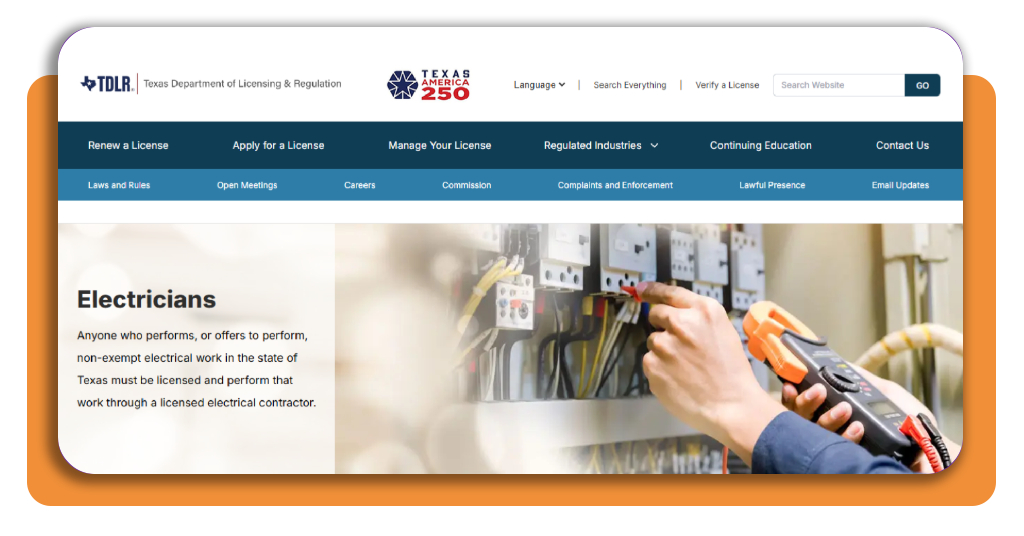
For example, in Texas, electrician licensing is handled by the Texas Department of Licensing and Regulation.
Step 2: open the official electrician licensing page
Open the government result and confirm that the page specifically covers electrician licensing.
Step 3: choose the license category you want
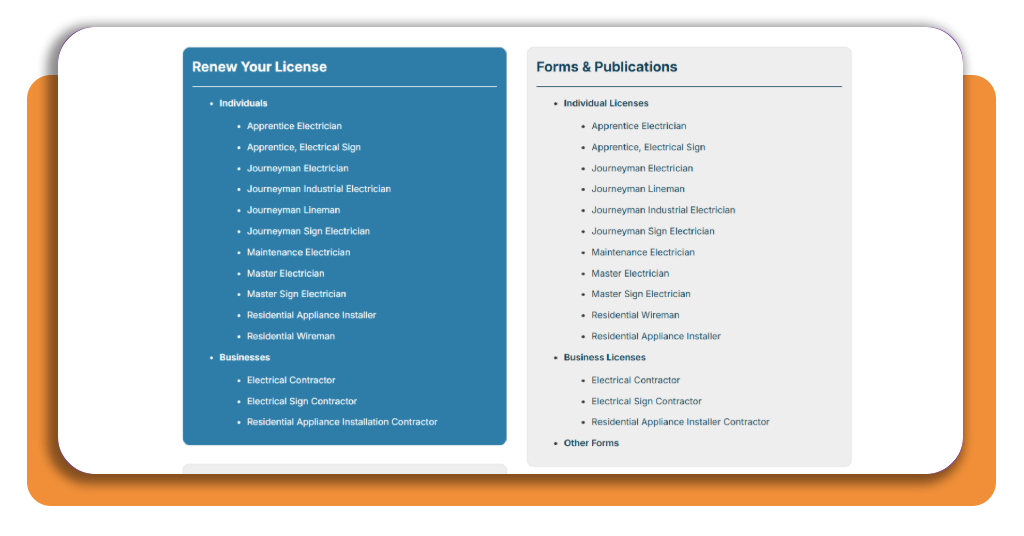
Open the category that matches your intended career path, such as Apprentice Electrician, Journeyman Electrician, or Master Electrician.
The available categories and their names vary by state.
Understand licenses, course certificates, and training limits
An electrician license gives legal authorization to perform certain types of electrical work under the rules of a state or local jurisdiction.
However, a course certificate is different: it only shows that you completed a particular training program.
It is important for you to know that because finishing an online or classroom course doesn’t make you a licensed electrician.
You may still need documented work experience, an apprenticeship, an exam, an application, and other requirements set by the licensing authority.
For that reason, training programs can be valuable for building technical knowledge or preparing for the next step.
The problem comes when a course is treated as if it replaces the professional requirements imposed by the state.
Remember to compare the course description with the exact license category you want.
Also, check whether the program supports any required education or exam preparation, and confirm what still has to be completed afterward.
The safest rule is simple: let the licensing agency define what qualifies you to work, and let the training provider explain only what its course actually teaches.
Where to access official licensing and exam guidance
Official electrician license agencies should be your main source for application rules, exams, fees, experience requirements, and renewal procedures.
Even though these details can vary significantly from one state to another, general career websites shouldn’t replace the agency responsible for licensing.
The Bureau of Labor Statistics electrician profile, for instance, provides broader career context and confirms that licensing requirements vary by state.
For the actual application process, however, you should move from that general information to the authority that regulates electricians where you plan to work.
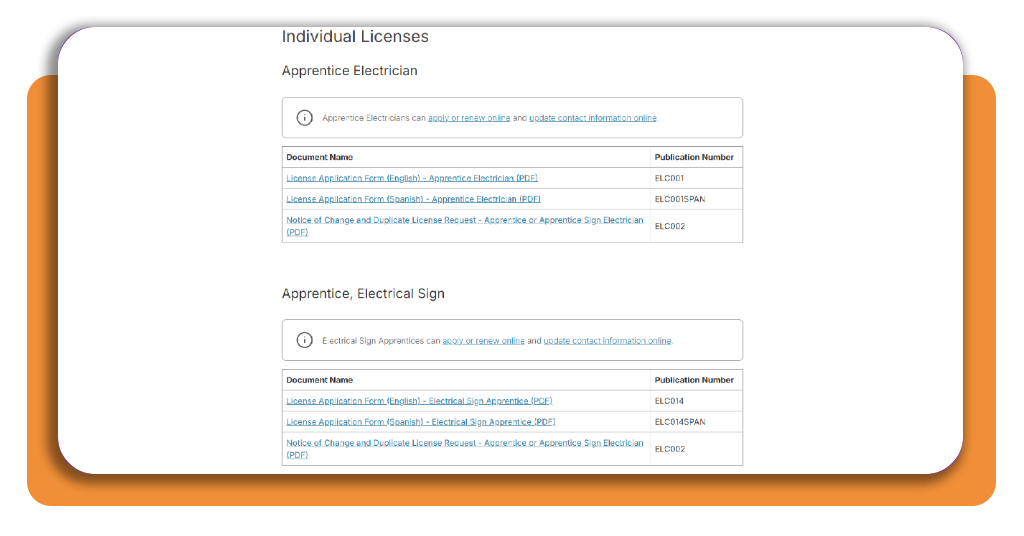
The Texas Department of Licensing and Regulation separates electrician license categories and publishes information about applications, examinations, renewals, and other requirements.
Nevertheless, those rules apply exclusively to Texas and should not be treated as national standards.
Before paying for exam preparation or training, confirm which license category you need and which exam, experience, or education requirements apply to it.
That keeps your preparation tied to the rules you will actually have to meet.
Choose training that matches your electrical career path
When it comes to electrical training, the program should match the license or type of work you actually want to pursue.
A short introductory course may be enough to explore the field, but it will not replace the experience, apprenticeship hours, exams, or other requirements that a licensing authority imposes.
That said, begin by identifying the role you are aiming for, then compare the official requirements with what the training program provides.
Also, pay attention to whether the course offers basic theory, hands-on instruction, exam preparation, or credit toward a formal training requirement.
If you are still at the exploratory stage, Insiderbits has a guide to a free electrician course online with certificate that introduce core concepts before you commit to a longer program.
Then, confirm that the training supports your intended path.
The right course is not simply the one that offers a certificate, but the one that fits the licensing and experience requirements you will eventually need to meet.
Check the license before paying for training
As you can see, electrician license rules change by state, license category, and sometimes by local jurisdiction, so checking the requirements gives you an idea of what you’ll need.
A course certificate can support your preparation, but it does not replace a professional license.
The value of the training depends on how well it fits the path defined by the licensing authority.
Lastly, comparing the program with the exact license you want to pursue makes it easier to choose training that supports your next step instead of simply adding another certificate.
Enjoyed this article? Save Insiderbits to your favorites and discover the most useful tech tips.