

If you want to become an electrician, an apprenticeship is one of the best ways to learn the trade while gaining real work experience.
Apprenticeship.gov lets you search opportunities by occupation and location, review individual listings, and follow the application process with the employer or program sponsor.
How to become an electrician through apprenticeship programs
An apprenticeship is one of the standard routes into electrical work. This path merges supervised job experience with technical instruction.
With that, you don’t learn how to become an electrician only in a classroom, apprentices build skills while working under experienced electricians.
Still, programs have variations in length, pay, classroom requirements, and entry standards.
Some opportunities are part of Registered Apprenticeship programs, while others may be employer-led training positions, so each listing should be reviewed with attention.
It is common for apprentices to be expected to learn electrical theory, safety procedures, wiring methods, code requirements, and the use of tools and testing equipment.
If you want to take a look, Apprenticeship.gov is our recommendation to start.
The platform lets you search by occupation and location, then open individual listings to review requirements and application instructions.
Completing an apprenticeship prepares you for advanced electrical work, but licensing requirements depend on the state or locality where you plan to work
Step-by-step: how to find and apply for electrician apprenticeships
Apprenticeship.gov gives you a central place to search opportunities, but the actual application happens with the employer or program sponsor listed in the posting.
Step 1: search for electrician opportunities
Open the Apprenticeship Job Finder and search for an electrician together with your city, ZIP code, or state.
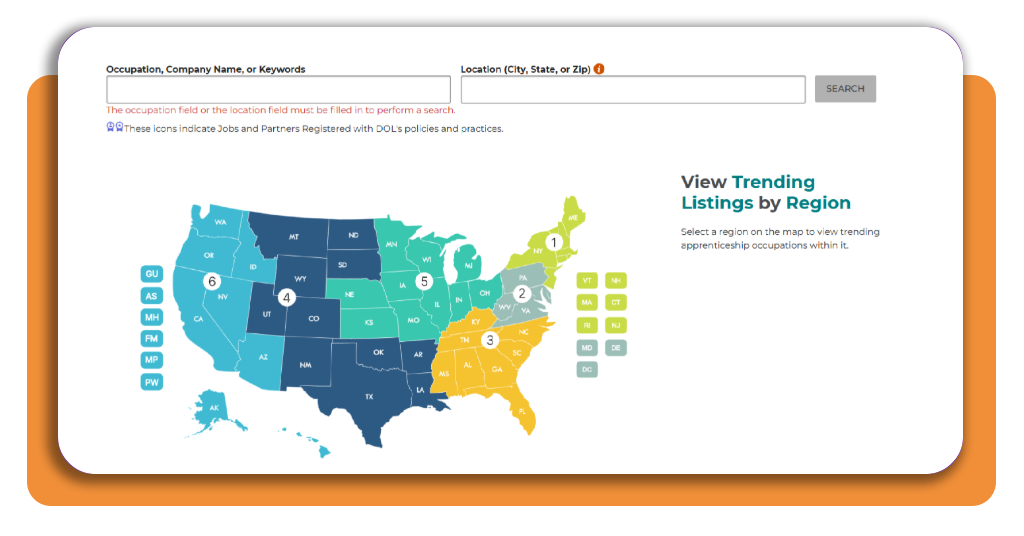
Step 2: open a listing and review the details
After that, check the employer or sponsor, location, requirements, training structure, and any information about pay or classroom instruction.
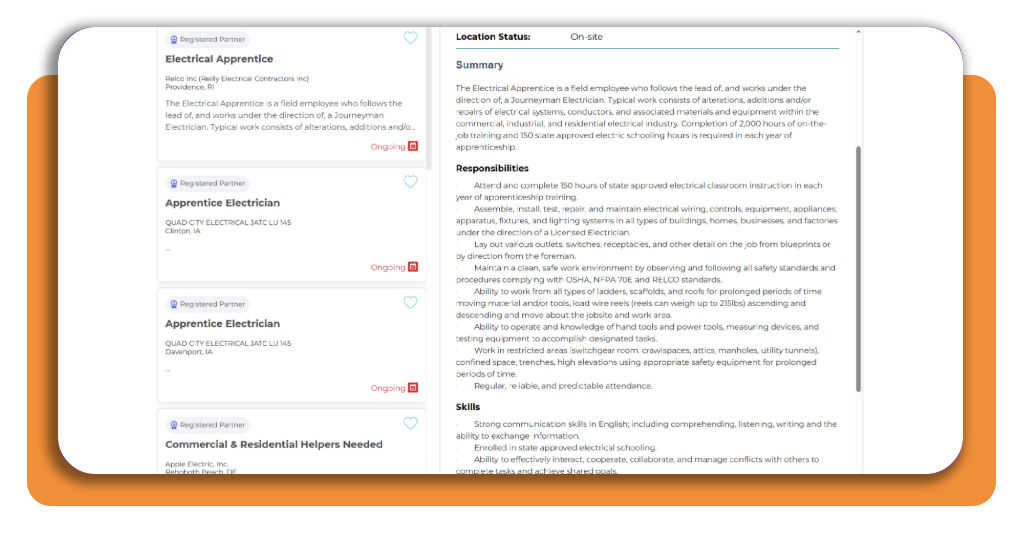
Step 3: compare the requirements
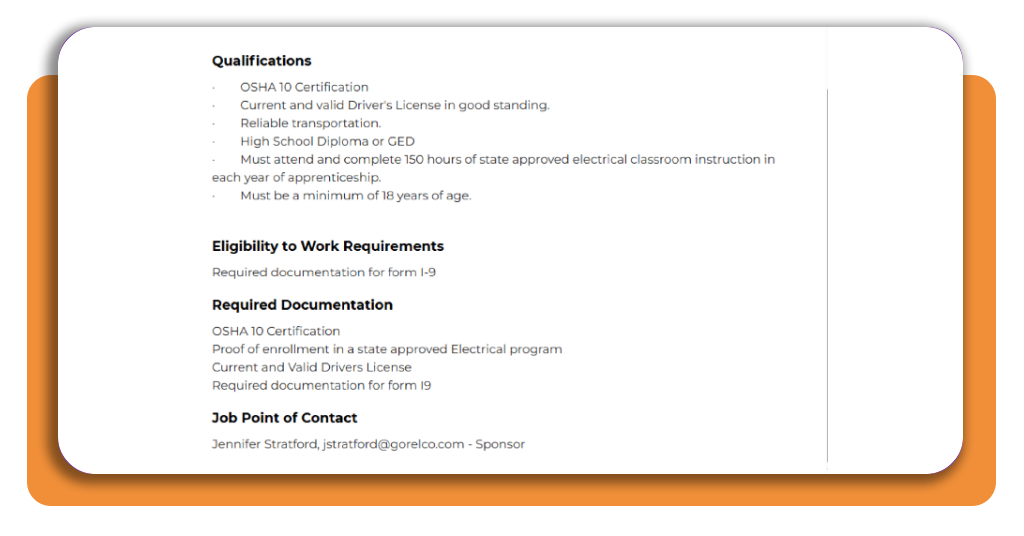
Look for education requirements, age limits if stated, driver’s license needs, physical requirements, testing, and other conditions listed by the sponsor.
Requirements vary, so compare several opportunities instead of assuming they all follow the same entry process.
Training requirements, skills, and what apprentices can expect
Electrician apprenticeships incorporate supervised work with technical instruction, so the experience is more demanding than a short course.
So apprentices gradually take on more complex tasks as they build skills and understand the safety standards required for electrical work.
When training to become an electrician, it commonly covers electrical theory, wiring methods, blueprint reading, safety procedures, mathematics, and electrical code requirements.
However, the exact curriculum, number of classroom hours, and length of training depend on the program.
Entry requirements also vary because some sponsors ask for a high school diploma, a valid driver’s license, or the ability to meet physical demands associated with construction work.
Also, apprentices should expect to work under supervision and receive pay that may increase as they progress through the program.
The starting rate, scheduled raises, benefits, and training costs need to be checked in each individual opportunity rather than assumed.
The goal is to build enough classroom knowledge and hands-on experience to move toward qualified electrical work.
Where to find electrician apprenticeship opportunities near you
The official Apprenticeship.gov Job Finder is one of the best places to begin with because it lets you search by occupation and location.
After accessing, enter ‘electrician’ with your ZIP code to see opportunities connected to employers and program sponsors.
Then, check the employer or sponsor, location, entry requirements, training details, and the application instructions before deciding whether the opportunity fits your goals.
The site also uses labels such as Registered Occupation and Registered Partner.
Those labels are important because not every result should be treated as a confirmed Registered Apprenticeship program.
For a broader overview of the apprenticeship path, the Apprenticeship.gov resources for career seekers explain how programs work and how to explore opportunities.
If you don’t find a suitable opening right away, it can also be worth checking local electrical contractors, unions, community colleges, and workforce agencies, since opportunities may be advertised outside the federal search tool.
Explore more electrical training and career opportunities
An apprenticeship is a recommended route into electrical work, but it is not the only place to build knowledge.
Introductory courses help everyone interested to understand basic electrical concepts before committing to a longer training program.
That said, online training is useful for learning fundamentals like electrical safety, circuits, tools, and terminology, and then, becoming an electrician.
Still, all this online studying doesn’t replace supervised apprenticeship hours or state licensing requirements, but it can make the transition into formal training easier.
For that case, Insiderbits also has a guide to a free electrician course online with certificate for people who want to explore the field before applying for an apprenticeship.
As your skills improve, you can also look at related paths such as residential wiring, commercial electrical work, industrial maintenance, and specialized systems.
The requirements differ, so compare the training and licensing rules for the type of electrical work you want to pursue.
Once you complete all training and apprenticeships, and become an electrician, you might expect to earn $63,190 per year, as the Bureau of Labor Statistics states.
Build experience prior chasing the license
As you might expect, if you want to become an electrician it takes more than completing a short course.
Apprenticeships provide the combination of supervised work and technical instruction needed to build practical experience in the trade.
Apprenticeship.gov makes it easier to find opportunities and compare requirements, but each employer or sponsor controls its own application process.
The next move is to compare programs and understand what each one offers. A good apprenticeship should give you a clear path to develop skills and accumulate experience.
Enjoyed this article? Save Insiderbits to your favorites and discover the most useful tech tips.