

Somewhere in a former employer’s files, a pension check or forgotten 401(k) balance may carry your name, and missing retirement credits could add a meaningful boost to the monthly income.
This guide by Insiderbits points you toward free search tools, planning services, and the tax correction options that can recover the benefits you’ve worked so hard to earn. Keep reading!
How the U.S. retirement system works
Congress sets the tax rules for retirement plans, the Department of Labor polices your employer under a 1974 law called ERISA, and Social Security pays out of current payroll taxes.
A layoff, a merger, or a move can leave missing retirement credits tied to a plan you lost track of, and knowing the plan type tells you where to look.
Traditional pensions once anchored private employers until 401(k) accounts took over, and the plan you hold may look different from the one your parents or grandparents relied on for income.
Pensions that pay a set monthly amount
Your employer pays into a shared trust, and a formula built on your years of service, and your final salary decides the size of the monthly check you will receive.
Married retirees receive a joint annuity that protects a spouse, unmarried retirees receive payments for life, and a federal insurer named PBGC backs private plans if employers fail.
Personal accounts like 401k plans and IRAs
A 401(k) or IRA holds a balance in your name, fed by paycheck contributions and any employer match, and the investments you pick decide whether that balance grows or shrinks.
Rolling an old account into an IRA or a new employer plan keeps the balance moving with you, while missing retirement credits tend to come from accounts nobody rolled over.
Tax advantages built into retirement plans
The money you put into a traditional 401(k) or IRA skips income tax on the way in, grows without the yearly tax bills, and becomes taxable income when you withdraw it.
Roth accounts flip the order by taxing contributions up front and releasing qualified withdrawals tax-free, and taking money out before age 59 and a half can trigger a penalty.
Ways to check for missing retirement credits
Records from old jobs spread across several databases, and those databases differ in the plan types they cover, the personal details they require, and the way they show your results.
A list of former employers with rough dates and addresses helps you recognize missing retirement credits when a search returns a company you forgot or one that changed owners.
Keep a running note of every match with the plan name, the administrator’s contact details, and the date you searched, and you’ll have what you need for follow-up calls.
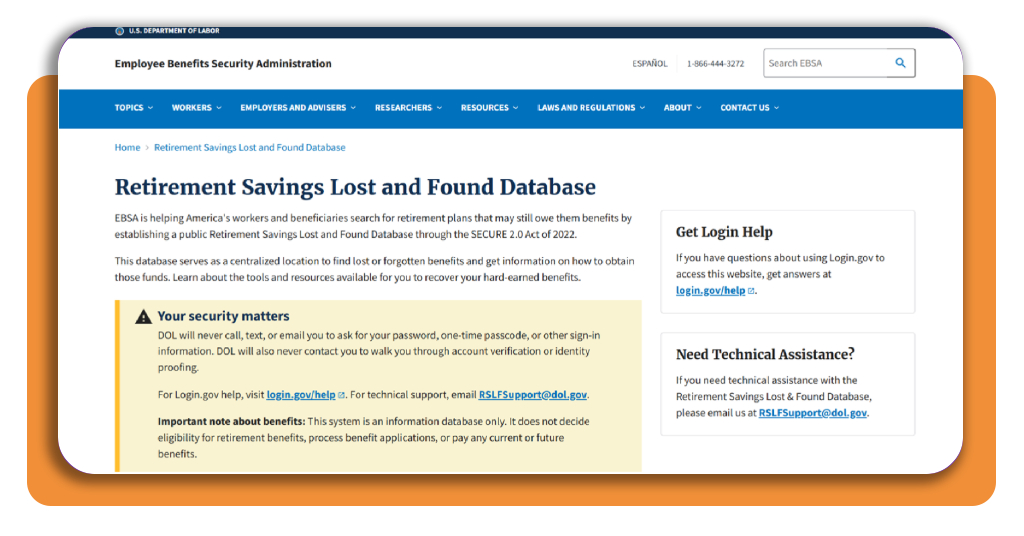
Retirement savings lost and found database
The Department of Labor runs this free search, and you sign in with a Login.gov account verified with your name, birth date, Social Security number, phone, and driver’s license photo.
Results list private employers and unions tied to your number with administrator contacts, and the administrator confirms any balance, though IRAs never appear in this database.
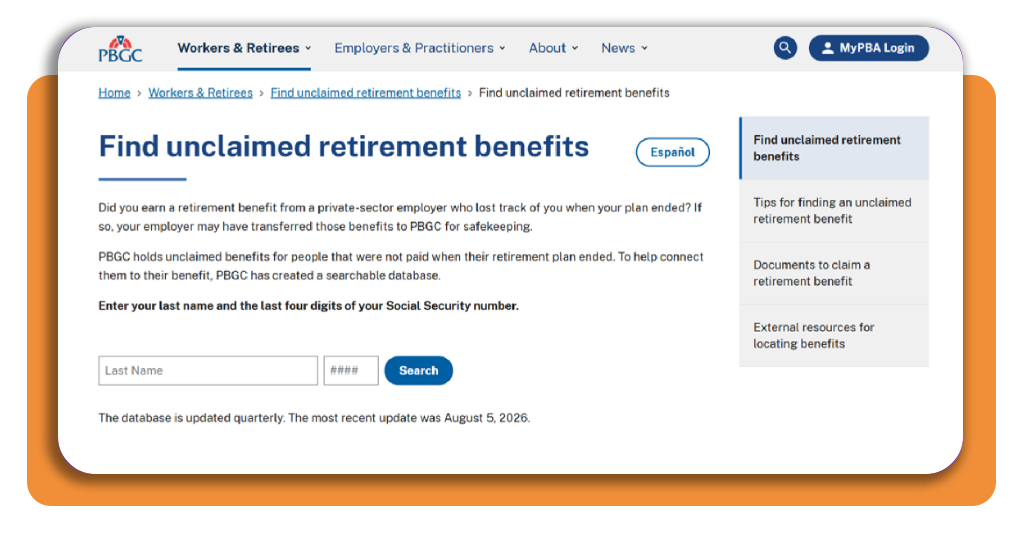
Pension Benefit Guaranty Corporation (PBGC)
The PBGC may hold your benefit when a private employer ends a plan and can’t find you, and its search needs your last name and last four Social Security digits.
It updates the database every quarter, with the latest refresh on August 5, 2026, and its site lists documents you need to claim a benefit after a match appears.
National Registry of unclaimed retirement benefits
This registry is a database where employers and administrators post the names of participants they couldn’t reach, and a search can turn up missing retirement credits from old jobs.
Employers file records under the name they had on their payroll, and a maiden name, a nickname, or an old spelling could be the one that returns a valid match.

National Association of Unclaimed Property Administrators (NAUPA)
NAUPA links the unclaimed property programs state treasurers run, and its MissingMoney site lets you search for free, covering uncashed payroll checks, stocks, and forgotten balances.
Plans can report uncashed retirement checks to a central state resource, and you can search every state where you worked or lived through the official program links on its site.

Top national retirement planners
Locating an old benefit gives you a number, and a financial professional turns that number into a monthly income plan that accounts for taxes, healthcare costs, and the years ahead.
National services differ in how they charge, how much time you spend with a person, and what savings level they work with, and those differences decide who fits your situation.
When you recover missing retirement credits, an expert can fold that extra money into your monthly budget and show you how it shifts the age you can leave your job.
Retirable pairs you with a fiduciary advisor
Retirable assigns you a dedicated advisor who works as a fiduciary and puts your interests first, then builds a plan that adjusts as your income needs and health costs change.
A monthly payment arrives like a paycheck and shows how much is safe to spend, and the service adds identity theft insurance worth $1 million along with credit monitoring tools.
Facet Wealth offers flat fee CFP guidance
Facet charges a flat membership fee with no commissions, and a CFP professional leads your retirement plan, covering Social Security timing, Medicare, healthcare costs, and tax moves.
Membership comes in three levels, and the top tier adds a tax specialist’s analysis plus direct indexing for tax loss harvesting, while a free quiz scores your financial wellness.
Empower lets you test retirement scenarios
Empower’s Retirement Planner lets you test different ages, add goals like a home remodel or a dream vacation, and set up withdrawals that cover daily expenses alongside those goals.
Add any balance, including missing retirement credits, and the projection updates as you adjust your plans, while advisors support clients with more than $250,000 invested with Empower.
Best options for correcting tax records
Money you recover from an old plan can change the tax return you filed, and the IRS gives you a formal route to correct that return through an amended filing.
An amended federal return can bring you an additional refund or a higher tax bill, and your home state expects a matching correction submitted on the state’s own amendment form.
When your search for missing retirement credits points to a tax form you never received, comparing it with your filed return shows whether an amendment makes sense for that year.
Mistakes worth fixing with an amended return
Amend when you chose the wrong filing status, added or dropped a dependent by mistake, missed a deduction or credit, forgot taxable income, or took an expense you couldn’t claim.
The IRS corrects math slips and clerical errors on its own and mails you a bill or a refund, and your original return should finish processing before you amend it.
Paperwork and forms you need to amend
Form 1040-X lists original figures in one column, the change in a second, and the corrected totals in a third, and Part III asks you to explain why you’re amending.
Order a tax transcript if your original return is lost, then collect any new W-2 or 1099 forms, receipts, and letters that confirm your missing retirement credits, plus affected schedules.
Deadlines and processing times to keep in mind
To claim a federal refund, file your amended return within three years of the original filing deadline or within two years of paying the tax, and use the later date.
E-filing works for tax year 2019 onward when your software supports it, while mailed amendments take 8 weeks or longer and appear in IRS tracking about 3 weeks after mailing.
Unclaimed years can still pay you back
Your old jobs may have left savings in places you never thought to check, and now you know where to knock, who to ask, and what to bring along.
With this Insiderbits guide, you learned how to track missing retirement credits with free tools, turn that money into a paycheck with an advisor, and fix tax mistakes.
Read other Insiderbits articles about finding missing money to spot forgotten refunds, old bank balances, and uncashed checks that carry your name, then go collect all that’s yours.