

If you left a company without transferring your retirement plan balance, you may have an unclaimed 401k waiting to be located. It could be sitting in a low-yield account or accumulating maintenance fees.
With every career move, job transition, or corporate merger, a paper trail of benefits gets left behind. As a result, over $1.65 trillion in 401k assets are unclaimed across the U.S. Read on Insiderbits.

4.5/5
App to find unclaimed 401(k) accounts and missing retirement money
In today’s dynamic job market, the average American worker changes employers 3 to 7 times over their career.
Retirement plan custodians can lose contact with account holders after address changes, name changes, or long periods without account activity.
For that reason, searching for an unclaimed 401k can be an effective way to recover forgotten savings and strengthen your long-term financial security.
Tracking down a forgotten account used to require hours of manual phone calls, physical letter requests, and tedious navigation through state unclaimed-property databases.
Today, mobile software streamlines this process into an automated search.
Using an unclaimed 401k finder app allows you to cross-reference your past work history against public Department of Labor filings, national registry databases, and plan custodian directories.
If you suspect that a former employer holds retirement balances in your name, downloading an app like Asset Recovery (iOS | Android) gives you immediate access to search the app’s search tools on your smartphone.
Key features within the Asset Recovery: Lost 401k platform
Key technical capabilities of the platform include:
- Automated employment scan: input your previous employer names and work timelines to automatically cross-match corporate Form 5500 filings and plan administrator records;
- National registry cross-referencing: simultaneously query state unclaimed property archives, the National Registry of Unclaimed Retirement Benefits, and federal databases;
- Plan custodian identification: identify which major brokerage or recordkeeper (such as Fidelity, Empower, Schwab, or Vanguard) currently holds your unclaimed 401k funds;
- Forced transfer and cash-out detection: discover if an old employer transferred your small-balance account ($1,000 to $5,000) into a Default Safe Harbor IRA or escheated it to a state treasury;
- Direct rollover guidance: access built-in instructions and required paperwork to transfer an unclaimed 401k directly into an Individual Retirement Account (IRA) without triggering IRS tax penalties.
Step-by-step: how to track down unclaimed 401(k) funds and rollover balances
Reclaiming control over a forgotten retirement account requires a systematic approach to prevent accidental tax withholdings or early withdrawal penalties.
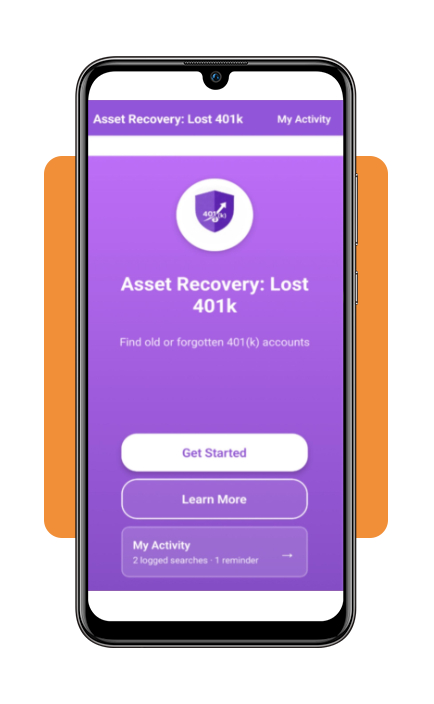
Step 1: download and set up asset recovery
Install the app (iOS | Android) on your smartphone using the official store links. Open the app and set up your secure profile by providing basic identification details required to verify your search identity.
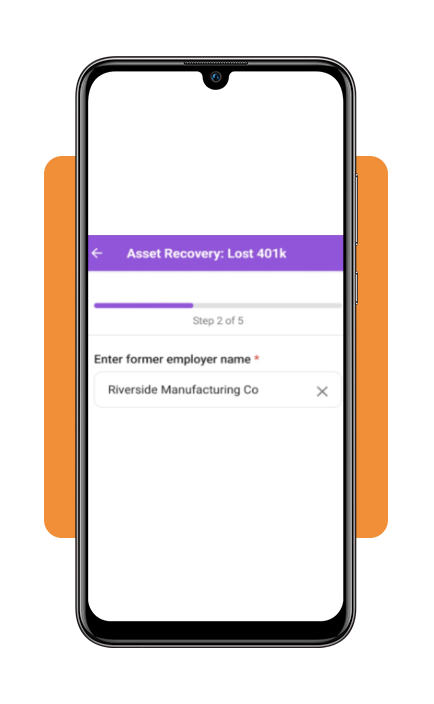
Step 2: build your previous employment history
List every company you worked for that offered a 401(k) or pension plan. Include approximate employment start and end years, former corporate names, and any legal name changes you have had since leaving those jobs.
Step 3: run the database scan
Launch the app’s automated search engine.
The platform cross-references your work timeline against federal ERISA database records, state unclaimed property archives, and the National Registry of Unclaimed Retirement Benefits.
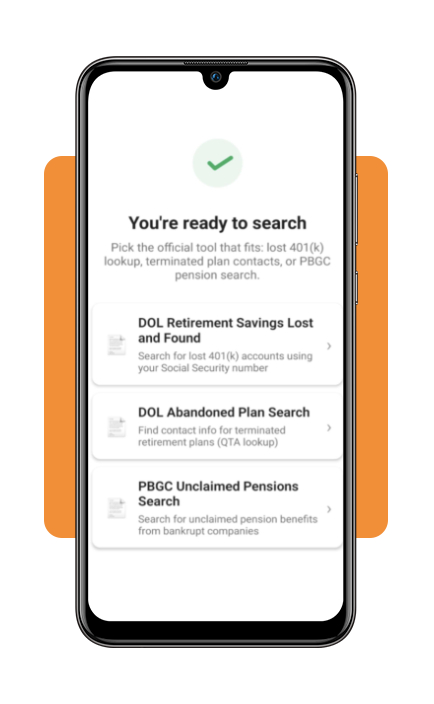
Step 4: review matched accounts and custodian details
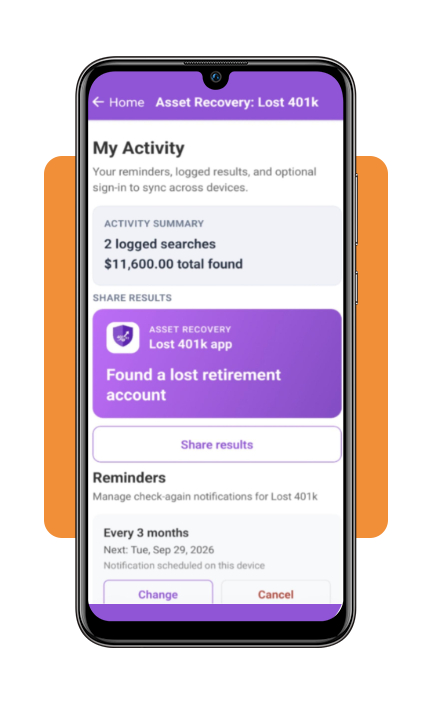
Examine your search results to identify which financial institution (such as Fidelity, Vanguard, Empower, or Schwab) holds your funds.
Check whether your account remains in the original company plan or was transferred into a Default Safe Harbor IRA.
Top 401(k) rollover platforms
Leaving an unclaimed 401k with a former employer often exposes your savings to high administrative recordkeeping fees and narrow investment options.
Rolling recovered funds into a self-directed Individual Retirement Account (IRA) gives you full control over investment selection, expense ratios, and asset allocation.
Always request a direct trustee-to-trustee rollover into a self-directed Individual Retirement Account (IRA) or your active employer plan to prevent mandatory 20% federal tax withholdings
When selecting an IRA custodian to house your recovered unclaimed 401k balances, compare market options.
| Brokerage / Platform | Account Minimum | Annual Account Fees | Investment Selection | Best Suited For |
| Fidelity Investments | $0 | $0 maintenance fee | Stocks, ETFs, mutual funds, zero-expense index funds | Hands-on investors seeking comprehensive research tools |
| Vanguard | $0 | $0 with e-delivery | Industry-leading low-cost index funds & ETFs | Long-term buy-and-hold index fund investors |
| Charles Schwab | $0 | $0 maintenance fee | Broad stock/ETF selection, fractional shares, automated portfolios | Investors wanting local branch support and strong research |
| Betterment | $0 | 0.25% annual management | Automated robo-advisor portfolios, automated rebalancing | Hands-off investors who prefer automated portfolio management |
Consolidating multiple unclaimed 401k accounts into a single IRA platform drastically reduces management clutter and ensures your retirement assets remain organized under a single dashboard.
Finding forgotten funds is not limited to retirement accounts; many individuals who trace lost employer benefits also uncover broader missing assets using an unclaimed inheritance lookup tool.
Best high-yield savings accounts
In certain situations, tracking down an unclaimed 401k balance under $1,000 results in the plan administrator issuing a direct check liquidation, or you may receive temporary cash proceeds while transferring funds between custodians.
In these scenarios, storing liquid cash in standard checking or traditional brick-and-mortar savings accounts exposes your capital to inflation erosion due to near-zero interest yields.
Holding liquid capital or cash distributions in high-earning accounts ensures your money continues growing. Ahead, we outlined leading accounts for temporary cash placement:
If an unclaimed 401k forced cash-out lands in your bank account, transferring those funds into a high-yield account while finalizing your long-term IRA investment plan preserves your liquidity without forfeiting interest earnings.
Search centralized databases including the Department of Labor’s EFAST2 database, state unclaimed property division sites, and the PBGC Unclaimed Retirement Benefits Directory to identify terminated plans.
4.5/5
Why recovering an unclaimed 401k matters
Taking action to recover an unclaimed 401k is one of the most effective moves you can make to protect your financial future.
By utilizing specialized asset recovery mobile apps, following structured rollover protocols, and choosing low-cost rollover custodians, you can reclaim your forgotten wealth and build a stronger foundation for retirement.