

Whether you are actively facing paycheck discrepancies or searching for historical restitution, using an official digital tool lets you audit your income and claim unpaid wages owed to you.
Understanding how to track your daily work hours, calculate overtime accurately, and cross-reference public backpay registries can protect you from ongoing payroll shortages. Read on Insiderbits.

3.1/5
Which is the app to check for unpaid wages and backpay?
Millions of workers across the United States are underpaid every year due to illegal off-the-clock demands, improper overtime calculations, or uncompensated meal breaks.
When federal auditors uncover Fair Labor Standards Act (FLSA) violations, millions of dollars in recovered funds end up in government databases waiting to be claimed.
If you suspect your employer owes you money or want to verify past paychecks, checking for unpaid wages has never been easier or faster.
When searching for a reliable app to track work hours and check for unpaid wages, commercial shift-logging tools often come with subscription paywalls or privacy concerns.
The most effective, legally verifiable option is the official DOL Timesheet app, developed directly by the Wage and Hour Division (WHD) of the U.S. Department of Labor.
This free application serves as a personal time clock and wage audit tool.
By maintaining a timestamped record of your shifts, rest breaks, and overtime, the app empowers you to challenge employer payroll errors and present verifiable evidence if you need to file a formal claim for unpaid wages.
To begin logging your hours and safeguarding your paycheck, download the official application for iOS on the App Store or for Android on Google Play.
Key features within the DOL Timesheet platform
The official DOL Timesheet app (iOS | Android) is tailored to federal labor standards under the Fair Labor Standards Act, helping employees monitor their hours and identify unpaid wages in real time:
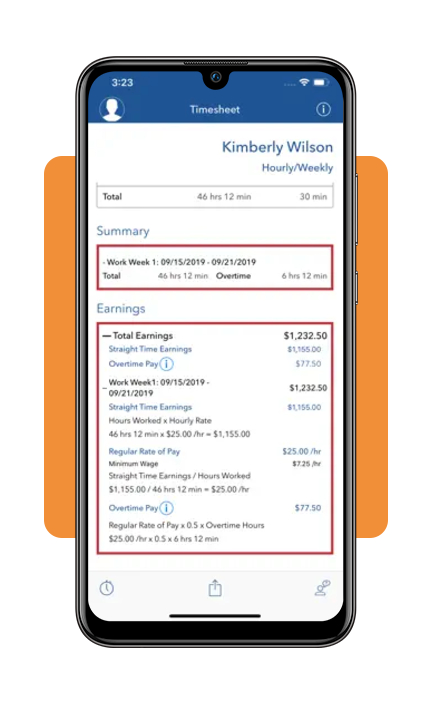
- Automated overtime calculation: computes overtime pay at 1.5 times your regular hourly rate for any hours worked beyond 40 in a single workweek;
- Multi-pay frequency support: accommodates weekly, bi-weekly, semi-monthly, and monthly payroll schedules to mirror your employer’s actual pay cycles;
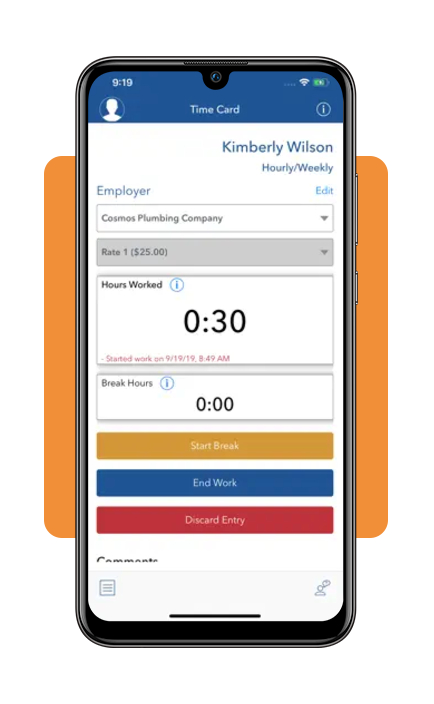
- Break logging: tracks regular work hours, meal periods, and unpaid rest breaks to ensure you are fully compensated for all working time;
- Shift note annotations: allows you to add custom comments to specific shifts, documenting mandatory pre-shift meetings, travel time, or supervisor instructions for off-the-clock labor;
- Bilingual capability: operates in both English and Spanish, making wage tracking accessible for a broader workforce.
Step-by-step: how to calculate unpaid wages and check backpay databases
If you suspect you have been shorted on your paycheck or want to search for unclaimed backpay from past employers, follow these steps to calculate unpaid wages and search federal government registries.
Step 1: log daily shifts and rest breaks
Download the DOL Timesheet app (iOS | Android) and log every shift start time, end time, and break duration. Include any mandatory pre-shift prep work or post-shift cleanup to ensure all hours are documented accurately.
Step 2: compare logged hours with official pay stubs
At the end of each pay period, export your logged timesheet report and compare your total hours against your physical pay stub.
Calculate any missing regular hours or overtime rates to determine your total estimated unpaid wages.
Step 3: search the Workers Owed Wages (WOW) database
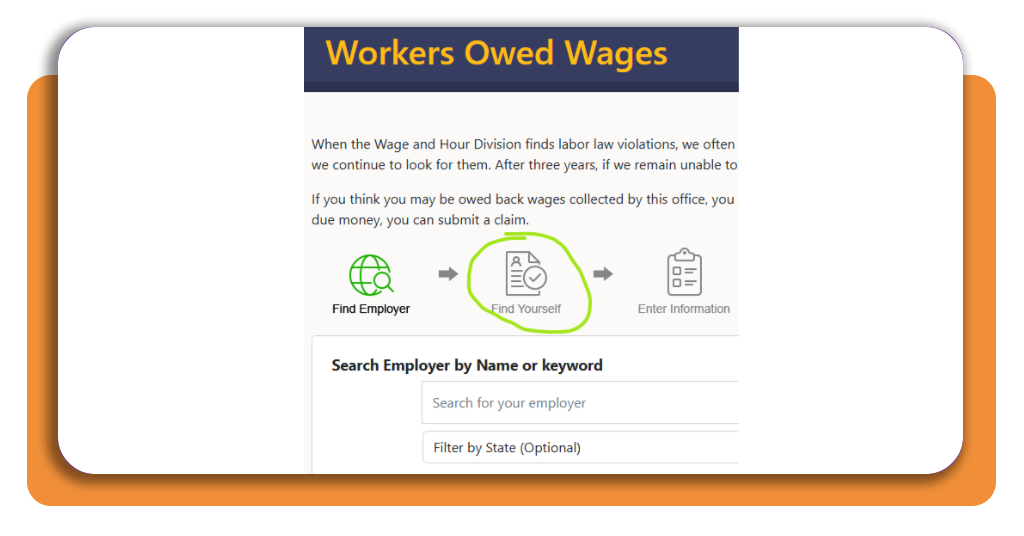
Visit the DOL Workers Owed Wages (WOW) portal.
Enter your former or current employer’s company name and state to see if federal auditors have already recovered funds on behalf of employees.
Step 4: verify your name and submit claim documents
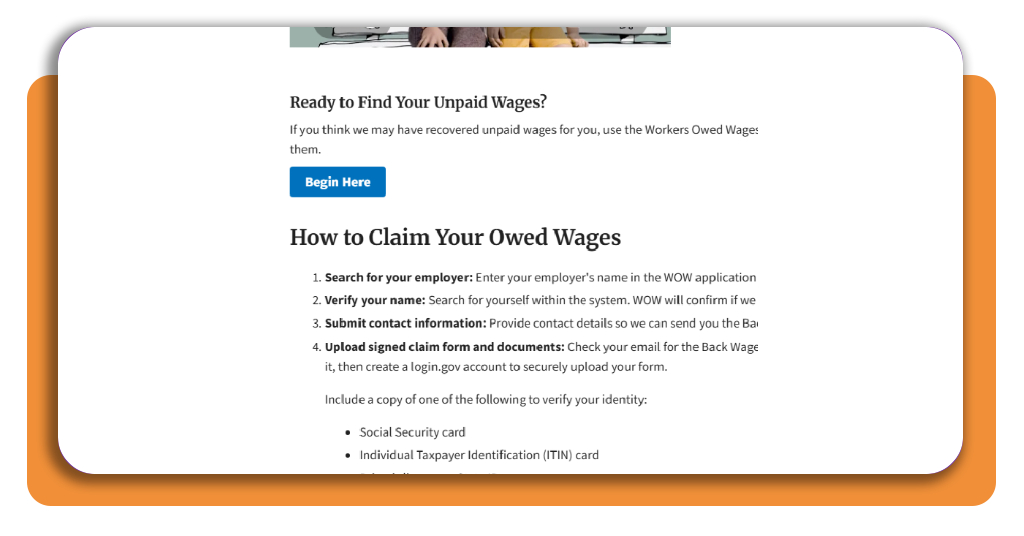
If your employer appears in the WOW database, enter your full legal name to verify if back wages are waiting for you.
Complete the online contact form to receive Back Wage Claim Form WH-60, sign it, and upload it alongside proof of identity.
Top worker advocacy organizations for unpaid wage claims
When dealing with employer retaliation, complex misclassification, or severe wage theft, working alongside specialized advocacy organizations can make a significant difference in recovering unpaid wages.
These non-profit bodies and regulatory agencies assist workers in navigating legal processes, filing formal complaints, and enforcing labor laws.
If federal audit records in the Workers Owed Wages (WOW) database do not list your former company, these advocacy groups can help initiate a new investigation or legal claim:
| Organization | Target Audience / Focus | Key Assistance Provided |
| U.S. WHD (Wage & Hour Division) | All U.S. hourly & salaried non-exempt workers | Enforces FLSA compliance, investigates wage theft, and recovers unpaid wages directly from non-compliant employers. |
| National Employment Law Project (NELP) | Low-wage workers, contractors, & marginalized labor | Provides policy advocacy, legal resources, and worker education on wage theft and employee misclassification. |
| Interfaith Worker Justice (IWJ) | Local worker center networks & low-wage labor | Operates community worker centers that offer wage claim assistance, legal referrals, and worker rights training. |
| State Departments of Labor (State DOL) | Local state-level employees | Enforces state-specific minimum wage laws, paid meal break mandates, and localized penalties for unpaid wages. |
Recovering missing wages often leads to significant financial adjustments during tax season.
If you receive a lump-sum backpay distribution, exploring your eligibility for federal tax credits through an EITC refund qualification guide can help you maximize your overall tax refund and financial return.
Best emergency financial assistance tools
While waiting for labor investigations or WOW claims to process—which can take several weeks to months—struggling with unpaid wages can create immediate financial hardship.
Tools and assistance resources to utilize during a wage dispute include:
- 211 community care network: call or search 211.org to connect with local utility relief programs, emergency housing stipends, and immediate food support networks;
- Government hardship grants (SNAP / TANF): apply through state social service portals for temporary food assistance and cash grants while your income is disrupted by unpaid wages;
- Non-profit credit counseling: organizations like the NFCC (National Foundation for Credit Counseling) offer free financial guidance and hardship arrangements to protect your credit score during income gaps;
- Zero-fee earned wage access (EWA) tools: certain employer-backed or independent financial apps allow temporary access to earned income without predatory payday loan interest rates.
3.1/5
Protecting your earnings
Taking a proactive approach today can help prevent future disputes, strengthen your financial security, and ensure that every dollar you’ve worked for ends up where it belongs: in your pocket.