

Millions of workers contribute to Social Security through payroll taxes (FICA) throughout their careers, yet earning Social Security disability benefits requires meeting strict criteria established by the SSA.
Fortunately, evaluating your financial history and medical documentation before submitting a formal application dramatically improves your odds of approval. Read on Insiderbits.

3.5/5
Understanding Social Security Disability eligibility
Navigating the Social Security disability system can feel daunting, especially when living with a severe medical condition that prevents you from holding gainful employment.
The initial approval rate for Social Security Disability Insurance (SSDI) claims typically sits under 35%, meaning over two-thirds of first-time applicants face initial denials.
Most rejections stem from insufficient work credits, earned income exceeding administrative thresholds, or incomplete medical records.
Accessing Social Security disability insurance (SSDI) provides a critical financial safety net, offering stable monthly cash distributions, annual cost-of-living adjustments (COLA), and eventual Medicare healthcare coverage.
Using an automated eligibility evaluation tool alongside our comprehensive government benefits finder allows you to assess your qualification status in minutes.
To review official federal guidelines directly, visit the SSA benefit eligibility portal.
Which is the app to check Social Security Disability (SSDI) eligibility?
To determine if you qualify for benefits before starting the lengthy application process, mobile software allows you to audit your work credits and medical profile directly on your smartphone.
The top-rated mobile application for assessing your claim status is the SSDI Benefits & SSA Disability app on the Apple App Store.
Rather than searching through hundreds of pages of federal regulations, the app guides users through a structured diagnostic questionnaire designed to mirror official SSA evaluation protocols.
Information SSDI Benefits & SSA Disability Platforms: iOS Size: 56.7 MB Downloads: N/A Ratings: 3.5 / 5 stars Price: Free Logo: https://is1-ssl.mzstatic.com/image/thumb/Purple211/v4/6d/9c/94/6d9c9427-98d0-31fc-6290-259931e3822e/AppIcon-1x_U007emarketing-0-11-0-85-220-0.png/200x200ia-75.webp
Key features within the SSDI Benefits and SSA Disability platform
- Work credit and quarters of coverage calculator: calculates whether you have accumulated enough work credits based on your age and recent employment history;
- Substantial Gainful Activity (SGA) earnings auditor: monitors your current earned income against the SSA’s monthly SGA limits to ensure your earnings do not trigger an automatic non-medical disqualification;
- Blue book listing evaluator: matches your diagnosed medical conditions against the SSA’s official Listing of Impairments (the ‘Blue Book’) to evaluate medical severity;
- Monthly payout estimator: projects your potential Primary Insurance Amount (PIA) based on your lifetime average indexed monthly earnings (AIME);
- Document checklist and appeal tracker: organizes required medical evidence, physician statements, and work history records while providing deadline tracking for reconsideration and administrative law judge (ALJ) hearings.
Step-by-step: how to verify SSDI eligibility and estimate your monthly payout
Determining whether you meet the requirements for Social Security disability payments involves reviewing both non-medical financial rules and strict medical definitions.
Step 1: Download and launch the app
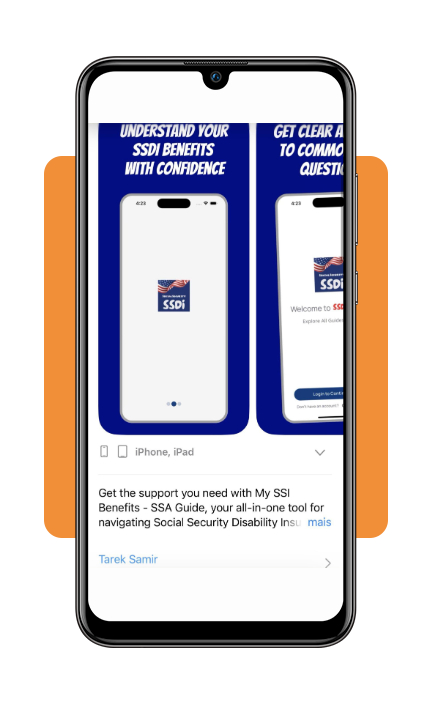
Install SSDI Benefits – SSA Disability from the Apple App Store. Open the application and choose your preferred language interface (English or Spanish).
Step 2: have your employment dates ready
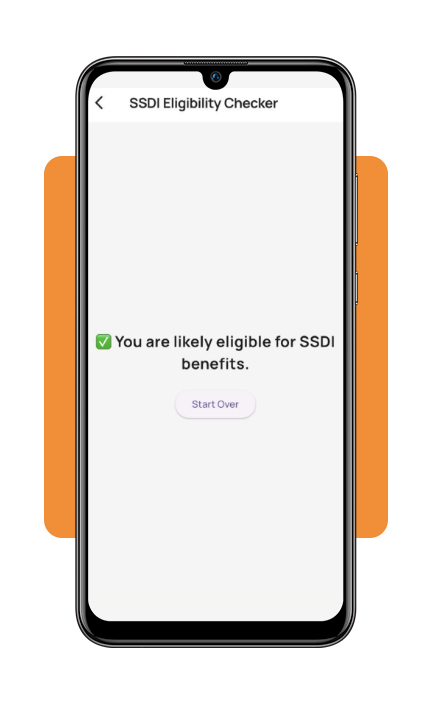
Navigate to the eligibility checker module.
Input your age and employment history to calculate your accumulated work credits, ensuring you meet the minimum required threshold (typically 40 total credits, with 20 earned within the last 10 years).
Step 3: audit earnings and medical severity
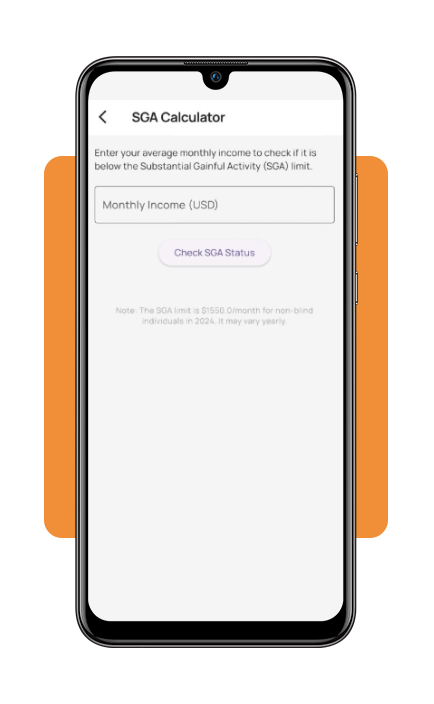
Complete the screening questions regarding your current gross monthly income and diagnosed medical conditions.
Confirm that your earned income falls below the Substantial Gainful Activity (SGA) cap and that your medical impairment is expected to prevent full work for at least 12 continuous months.
Step 4: calculate estimated monthly payout
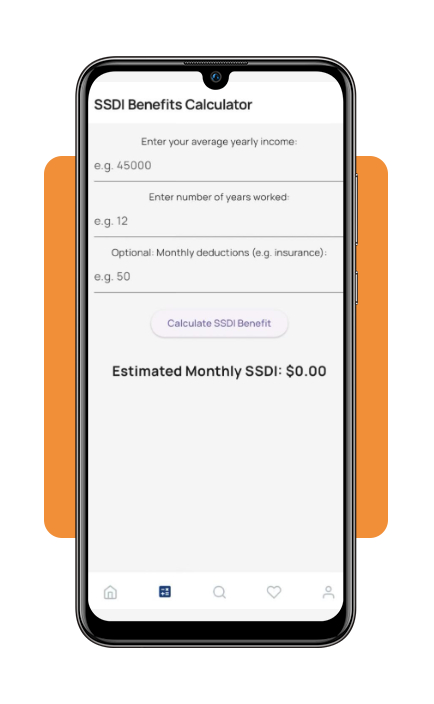
Enter your past average gross earnings into the payout calculator.
The app applies the federal Primary Insurance Amount (PIA) formula to estimate your projected monthly benefit check based on your historical taxed Social Security contributions.
Step 5: review checklist and connect to SSA
Review your generated eligibility score and payment summary.
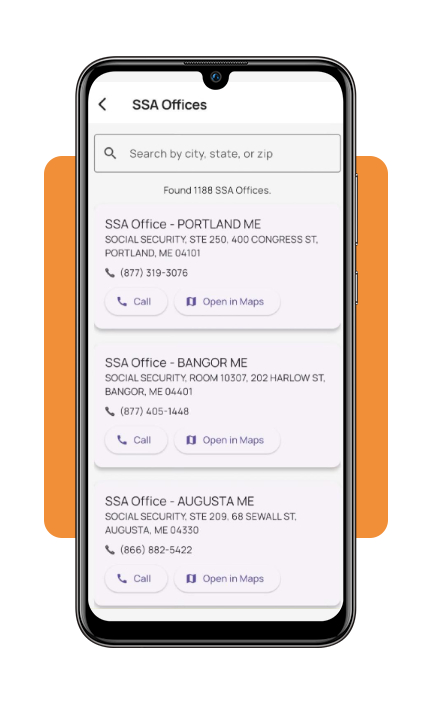
Use the built-in office locator tool to find your nearest Social Security Administration office or link directly to the official government portal to start your application.
Other benefits you may be entitled to
Achieving approval for Social Security disability benefits often serves as an entry point to additional federal, state, and auxiliary support programs.
Depending on your household composition and income, you may qualify for concurrent assistance programs:
| Benefit Program | Target Audience | Primary Requirement | Key Feature / Output |
| Medicare (Parts A & B) | Approved SSDI Recipients | 24-month waiting period after SSDI entitlement date | Comprehensive health coverage, hospital care, and medical insurance regardless of age. |
| Supplemental Security Income (SSI) | Low-Income / Limited Asset Individuals | Strict asset caps ($2,000 for individuals) and low income | Means-tested monthly financial support that can supplement low SSDI payments. |
| Auxiliary Dependent Benefits | Children & Dependents of Disabled Workers | Unmarried biological or adopted children under age 18 (or up to 19 if in high school) | Monthly cash payments up to 50% of the primary worker’s SSDI benefit amount (subject to family max). |
| State Disability Insurance (SDI) | Short-Term Disabled Workers | State payroll tax contributions (e.g., CA, NY, NJ, RI) | Temporary cash compensation bridging the 5-month SSDI waiting period. |
Furthermore, receiving Social Security disability payments unlocks priority access to state food assistance (SNAP), utility assistance programs (LIHEAP), and property tax exemptions in many jurisdictions.
Best financial planning tools for disabled workers
Managing long-term finances while living with a disability requires specialized financial instruments designed to protect benefit eligibility while building personal savings.
ABLE Accounts (Achieving a Better Life Experience)
ABLE accounts allow individuals who developed a qualifying disability before age 26 (expanding to age 46 in 2026) to save up to $18,000 annually in tax-advantaged growth accounts.
Crucially, account balances up to $100,000 are completely disregarded when evaluating eligibility for means-tested programs like SSI and Medicaid.
Special Needs Trusts (SNT)
A First-Party or Third-Party Special Needs Trust enables families to set aside assets or inheritance funds for a disabled individual’s care without forfeiting government benefits.
The trust pays for supplemental needs—such as specialized equipment, travel, education, and personal care—while preserving public assistance eligibility.
Ticket to Work & Trial Work Period (TWP) Tools
For individuals interested in attempting a return to the workforce, the SSA’s Ticket to Work program offers a 9-month Trial Work Period.
During this window, beneficiaries can receive full Social Security disability checks regardless of how much money they earn, provided they report their work activity accurately.
3.5/5
Preparation makes the process easier
Applying for disability benefits can feel overwhelming, but understanding the requirements ahead of time can make the process much smoother.
Reviewing your work credits, organizing medical records, and learning the SSA’s eligibility rules can help you build a stronger application.