

Picking the wrong month to claim Social Security can shave hundreds off your payments for life, and turning 67 in 2027 puts your full retirement age within reach along with some costly choices.
This Insiderbits guide teaches you to read your numbers in ‘my Social Security’ account and weigh each claiming age, helping you lock in the largest monthly check your work record allows.
What full retirement age means for your monthly check?
Social Security builds your monthly payment around one milestone birthday, and reaching your full retirement age is the moment the agency treats as the starting line for your benefit.
Claim anything before that birthday, and the payment shrinks, while waiting past it adds a monthly bonus on top, making this age the yardstick for all your claiming options.
Hitting 67 doesn’t require you to quit your job or file a claim, and you’re free to keep earning a paycheck while your benefit stays parked until you apply for it.
Receive 100% of your earned benefit
Social Security calls your full benefit the ‘primary insurance amount’, and it builds that number from the 35 years in which you earned the most, adjusting older wages for growth.
Claiming at 67 hands you 100% of that figure, and the 2027 ceiling at that age is $4,188 a month if you earned the taxable maximum for 35 years.
The 2027 raise boosts every check
Social Security approved a 3.6% cost of living raise for 2027, and your January payment marks the start of the bump, with the average retirement check landing near $2,170.
Waiting doesn’t cost you these raises, and the agency adds yearly increases to your benefit starting at age 62, building them into your check at full retirement age.
Medicare still begins at 65
Your Medicare eligibility arrives at 65 no matter what age Social Security uses for your benefit, giving you a two-year gap between health coverage and a full payment.
Unless you’re collecting Social Security before 65, signing up falls on you, and your enrollment window opens three months before your birthday month and closes three months after it.
Full retirement age 2027: what changes for people born in 1960
If your birth certificate says 1960, you’re among the first retirees required to reach 67 before Social Security will pay out your monthly benefit with no reduction attached.
Congress set this change in motion with a 1983 law that nudged the age two months at a time, and your birth year marks the final stop for full retirement age.
Headlines about a new retirement age in 2027 might make you nervous, but current law schedules no further increase, and the age you face comes from that original plan.
Born in 1960 means waiting until 67
Your 67th birthday lands somewhere in 2027, and the month you reach it is the first month your benefit qualifies for the 100% level you spent a career earning.
Social Security accepts applications up to four months before your chosen start date, and a May 2027 birthday would let you file in January and avoid a gap in income.
January 1 birthdays follow a different rule
If you were born on January 1, 1960, Social Security files your birthday under 1959, and that quirk moves your full retirement age to 66 and 10 months.
The same logic applies to any birthday on the first of a month, with Social Security figuring your benefit as though you were born in the month before.
Higher earnings limits in your milestone year
If you claim early and keep working, Social Security lets you earn up to $67,920 in 2027 before your birthday month without holding back a cent of your benefit.
Earn more, and the agency keeps $1 for each $3 above the limit, but that cap disappears once you turn 67, and any withheld money returns through a recalculated benefit.
Step-by-step: how to find your retirement age and estimate your benefit
Generic charts can show you the rules, but the numbers that shape your retirement come from your own work history, and you can see them with a free online account.
Pairing your birth year with that account shows you the date your full retirement age arrives and the dollar amount waiting for you at the claiming age you prefer.
If computers make you uneasy, a family member can sit beside you while you sign in, and Social Security’s phone line at 1-800-772-1213 can help if the website gives you trouble.
Step 1: find your birth year on the chart
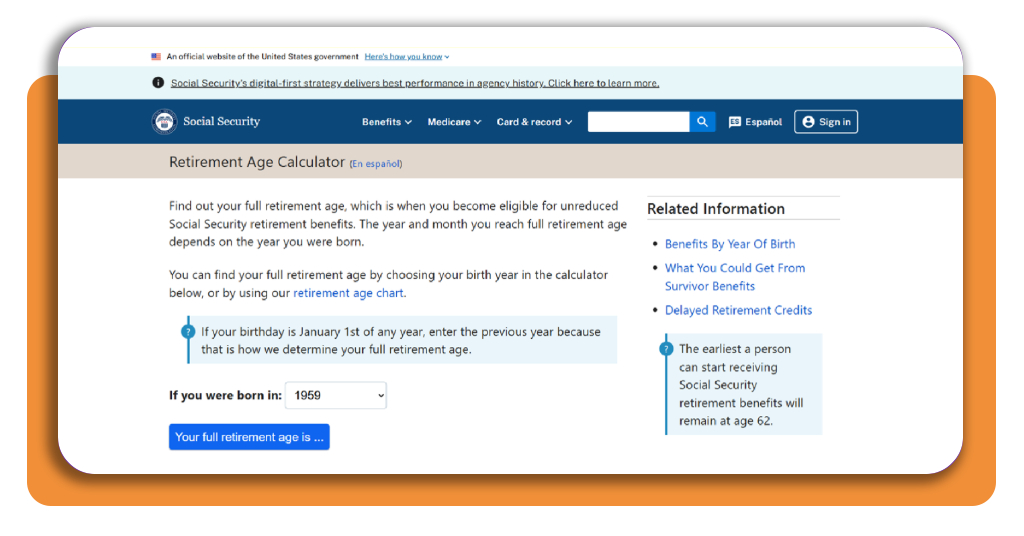
Visiting the Social Security retirement age calculator brings up the official chart, and entering your date of birth there reveals the month and year your full payment begins.
Check your spouse’s birth year on the chart, and if they were born before 1960, their unreduced benefit could arrive at an earlier age and change your timing as a couple.
Step 2: open your my Social Security account
Opening your ‘my Social Security account‘ requires your Social Security number and an email address, and you’ll confirm your identity through Login.gov or ID.me with a photo ID.
Once you’re in, review your earnings record line by line, and a missing year of wages could shrink the estimate you’ll see for your full retirement age.

Step 3: compare your estimates across claiming ages
Your Social Security Statement shows monthly estimates for claiming at any age from 62 to 70, letting you watch your check grow with every birthday you hold off.
Those estimates assume you’ll keep earning at your current pace until you claim, and the account’s ‘Plan for Retirement’ tool lets you test a different quitting date or claiming month.
How much claiming at 62 reduces your benefit
Claiming at 62 puts money in your hands five years before your 67th birthday, and that early start comes with a smaller check that Social Security calculates down to the month.
For the first 36 months you claim ahead of your full retirement age, the agency trims 5/9 of 1% per month, and the rate drops to 5/12 of 1% after that.
Pushing your claim to 64 shrinks the cut to 20%, and holding out until 66 leaves you with a reduction of about 6.7% on your monthly benefit amount.
A permanent 30% cut to your check
Claiming at 62 turns a $1,000 benefit into $700 for life, and your check stays at that lower level after you turn 67, with no automatic bump back to 100%.
Future cost of living raises apply to that smaller base, and a 3.6% increase on $700 adds $25.20 a month, while the same raise on $1,000 adds $36.
Working early can shrink your payments further
If you hold a job while collecting before 67, the 2027 earnings test lets Social Security keep $1 of your benefits for every $2 you earn above $25,560.
Earning $10,000 over the limit means Social Security holds back $5,000 from your benefits for the year, but income from your pension or investments stays out of that calculation.
One chance to undo an early claim
Social Security lets you withdraw your claim within 12 months of starting benefits, but you can only do it once, and you’ll need to repay all the money you received.
Miss that window, and your remaining option comes at full retirement age, when you can pause payments until 70 to grow your check, though the cut from claiming early stays attached.
Claim early, at full retirement age, or later?
Picking a claiming age comes down to how long you expect to be fit enough to work and how much savings you can lean on while you wait for a bigger check.
Delaying pays off once the larger checks make up for the payments you skipped, and that break even point tends to fall between your late 70s and early 80s.
Worries about the trust fund running low in 2034 might tempt you to claim fast, but any cut would hit checks at 62 and at full retirement age the same way.
Claiming early can make sense for some
A health condition or a family history of shorter lives can tilt the math toward 62, giving you more years of payments to enjoy while you feel well.
A layoff at 62 can turn a reduced check into a shield for your savings, and if you earned less than your spouse, claiming first lets their benefit keep growing.
Full retirement age offers a balanced middle
Filing at 67 lets you skip the early cut without betting on a long life, and your spouse can collect up to 50% of your amount if they wait until 67.
If you file after full retirement age, Social Security can pay up to six months of back benefits, though taking that lump sum erases the growth from those months.
Waiting until 70 pays the largest check
Every month you wait past 67 adds 2/3 of 1% to your benefit, and by 70 those delayed retirement credits push your check to 124% of its full amount.
Credits stop growing at 70, and waiting that long also protects your spouse, who can step up to your larger benefit as a survivor if you’re the first to pass away.
Lock in the check you spent decades earning
Your monthly Social Security check will follow you for decades, and taking a quiet evening to look over your numbers can spare you a choice you might regret at 80.
In this article, we explained what reaching full retirement age at 67 means for you, from the 30% price of claiming at 62 to the bonus that grows until 70.
Browse more Insiderbits and you’ll find articles on navigating retirement, from Medicare choices to budget tips that help you guard your savings and make your income go further.