
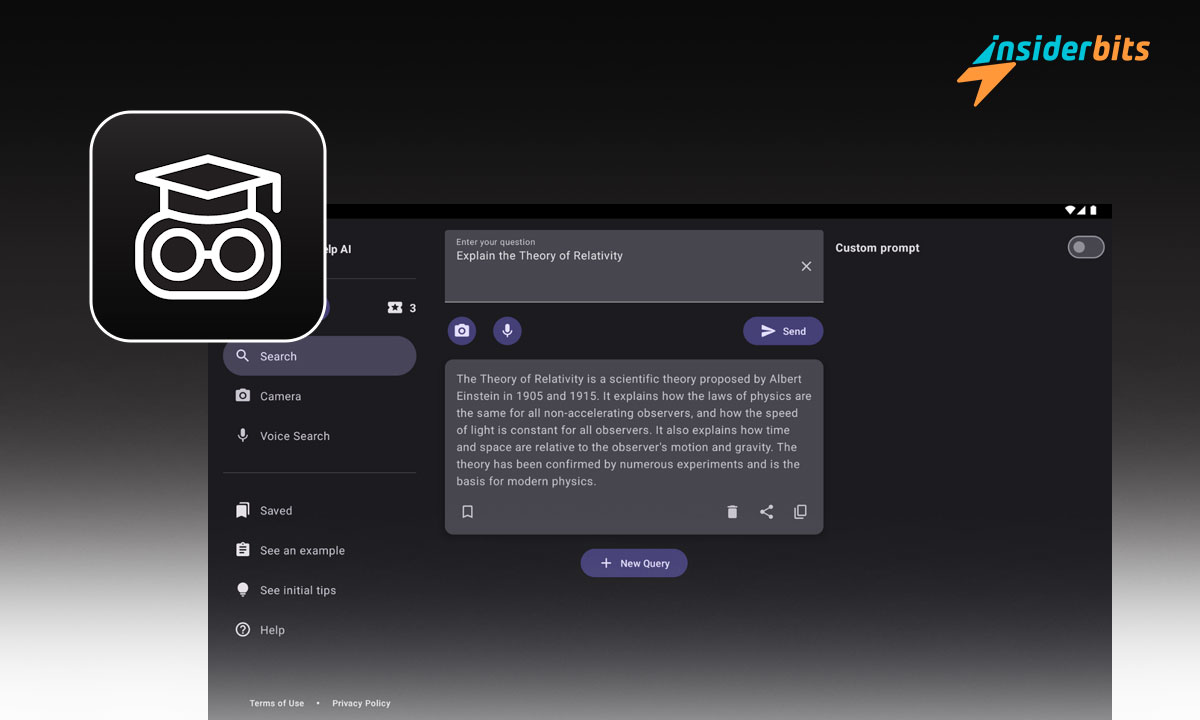
Les étudiants se tournent de plus en plus vers la technologie pour obtenir de l'aide, et les Aide AI se présente comme une aide aux devoirs de premier ordre en matière d'IA.
Cette application innovante d'aide aux devoirs AI offre une assistance personnalisée, permettant aux apprenants de s'attaquer facilement à des devoirs difficiles. Que vous ayez des problèmes de mathématiques, de sciences ou de rédaction, cette application vous offre des solutions instantanées et des conseils adaptés à vos besoins.
Lisez l'article ci-dessous pour découvrir les caractéristiques, les avantages et les expériences des utilisateurs de ce puissant outil qui transforme la façon dont les élèves abordent leurs devoirs.
Help AI : Your Homework With AI - Review (en anglais)
L'application Help AI est un outil destiné aux élèves qui souhaitent améliorer leur expérience des devoirs. En tant qu'aide aux devoirs par l'IA, elle propose des solutions rapides et précises dans un large éventail de matières, notamment les mathématiques, les sciences et la littérature.
L'interface intuitive de l'application permet aux utilisateurs de saisir facilement des questions et de recevoir un retour d'information instantané, accompagné d'explications détaillées qui favorisent une meilleure compréhension.
L'un des points forts de cette application de devoirs AI est que l'outil ne se contente pas d'aider à résoudre les problèmes, mais qu'il encourage également l'apprentissage autonome en expliquant clairement les concepts.
De plus, Help AI est conçu pour s'adapter aux styles d'apprentissage individuels, ce qui en fait une expérience personnalisée pour chaque utilisateur.
Cette application de devoirs AI est une ressource essentielle pour les étudiants qui souhaitent améliorer leurs résultats scolaires tout en réduisant le stress lié aux devoirs.

4.5/5
Help AI : Vos devoirs avec l'IA - Caractéristiques
- Réponses instantanées: Recevez rapidement des solutions précises aux questions de devoirs dans diverses matières.
- Explications pas à pas : Obtenez des explications détaillées qui vous aideront à comprendre des concepts et des processus complexes.
- Disponibilité 24 heures sur 24, 7 jours sur 7 : Accéder à l'aide aux devoirs à tout moment, en s'assurant que l'assistance est toujours à portée de main.
- Interface conviviale : Une conception intuitive qui facilite la saisie des questions et la navigation dans l'application.
- L'apprentissage personnalisé : Adapter les réponses en fonction des styles d'apprentissage et des préférences de chacun.
- Assistance à la formulation des textes : Aide les utilisateurs à rédiger, en leur proposant des suggestions de structure et de contenu.
- Des solutions pour gagner du temps : Réduit le temps consacré aux devoirs en fournissant des réponses et des explications directes.
- Large couverture des sujets : Il soutient un large éventail de sujets, y compris les mathématiques, les sciences et la littérature.
- Suggestions de solutions : Proposer des méthodes et des approches alternatives pour résoudre les problèmes.
- Apprentissage du renforcement : Encourage l'apprentissage autonome en expliquant clairement les concepts, ce qui favorise une meilleure compréhension.
Quelles sont les technologies d'IA spécifiques intégrées dans Help AI ?
Natural Language Processing (NLP)
Help AI utilise le NLP pour comprendre l'intention derrière les questions des utilisateurs, ce qui permet à l'application d'interpréter des requêtes complexes et de fournir des solutions pertinentes.
Transformateur génératif pré-entraîné (GPT)
L'application s'appuie sur GPT, un modèle linguistique de pointe, pour engager des conversations plus naturelles et contextuelles avec les utilisateurs. Les chatbots alimentés par GPT peuvent fournir des explications détaillées et des étapes de dépannage, et générer des réponses personnalisées.
Modèles d'apprentissage automatique
Help AI utilise des algorithmes sophistiqués d'apprentissage automatique pour comprendre et générer des réponses de type humain. En analysant le langage utilisé par les étudiants, le système d'IA interprète l'intention derrière leurs questions et fournit des solutions pertinentes.
Compréhension du langage naturel (NLU)
Help AI va plus loin dans le NLP en intégrant le NLU, qui permet au système de comprendre les nuances du langage. Dans le contexte de l'aide aux devoirs, le NLU permet à l'application de comprendre le sentiment qui sous-tend les demandes des étudiants et d'y répondre de manière appropriée.
Analyse statistique
Le système d'IA est formé sur de vastes ensembles de données, y compris les interactions historiques avec les étudiants et leurs résultats. En analysant rapidement ces statistiques, Help AI apprend à prédire les réponses les plus appropriées aux différentes questions des devoirs, améliorant ainsi la précision de l'aide fournie.
Comment Help AI gère-t-elle l'assistance multilingue ?
L'application Help AI gère efficacement l'assistance multilingue en s'appuyant sur des technologies avancées de traitement du langage naturel (NLP) et d'apprentissage automatique. Voici les principaux aspects de la gestion de cette fonctionnalité :
- Traduction en temps réel : L'application peut comprendre et répondre à des demandes dans plusieurs langues, ce qui permet aux utilisateurs de recevoir de l'aide dans la langue de leur choix.
- Détection des langues : Help AI détecte automatiquement la langue de l'utilisateur, assurant ainsi une communication transparente sans nécessiter de saisie manuelle de la part de l'utilisateur.
- Sensibilisation au contexte culturel : L'application est conçue pour s'adapter aux nuances culturelles et améliorer l'expérience de l'utilisateur en lui fournissant des réponses adaptées au contexte.
- Prise en charge d'un grand nombre de langues : L'IA d'assistance prend en charge un large éventail de langues, ce qui la rend accessible à un public mondial.
- Continuous Learning: L'application améliore ses capacités multilingues au fil du temps en s'entraînant sur divers ensembles de données, qui comprennent différents dialectes et contextes culturels.
Comment faire ses devoirs avec Help AI ?
- Commencez par télécharger l'application Help AI dans la boutique d'applications de votre appareil. Une fois installée, ouvrez l'application et créez un compte si nécessaire.
- Prenez le temps d'explorer l'interface conviviale de l'application. Familiarisez-vous avec les principales caractéristiques, telles que la zone de saisie des questions et la section des réponses.
- Lorsque vous rencontrez un problème de devoir, tapez votre question dans la zone de saisie prévue à cet effet. Soyez aussi précis que possible pour que l'IA comprenne votre requête.
- Après avoir soumis votre question, l'application Help AI génère une réponse en quelques secondes. Examinez attentivement la réponse, en prêtant attention aux explications fournies étape par étape.
- Au fur et à mesure que vous étudiez les solutions fournies par l'application, prenez des notes sur les concepts et les étapes clés. Cela vous aidera à renforcer votre compréhension et à vous préparer pour vos futurs devoirs ou tests.
- Utilisez la fonction de l'application pour revoir vos anciennes questions et réponses. Cela peut s'avérer utile pour étudier et revoir les concepts que vous avez appris précédemment.
- Avec l'aide de l'IA, faites vos devoirs en toute confiance, en sachant que vous disposez d'une ressource fiable.
Comment aider l'IA : vos devoirs avec l'IA ?
Pour télécharger cette aide aux devoirs de l'IA, suivez les étapes suivantes sur le Play Store :
- Ouvrez le Google Play Store sur votre appareil Android.
- Dans la barre de recherche, tapez Help AI : Your Homework With AI et appuyez sur Entrée.
- Sélectionnez l'application Help AI ou les résultats de la recherche.
- Appuyez sur le bouton Installer pour télécharger et installer l'application sur votre appareil.
En suivant ce guide, vous serez en mesure d'utiliser cette application de devoirs AI.
4.5/5
Rencontrer Help AI - Conclusion
L'application Help AI est une ressource inestimable pour les élèves qui cherchent de l'aide pour leurs devoirs. L'utilisation de la technologie de l'IA fournit des solutions instantanées et précises ainsi que des explications détaillées qui améliorent la compréhension et favorisent l'apprentissage autonome.
Grâce à son interface conviviale et à sa disponibilité 24 heures sur 24 et 7 jours sur 7, Help AI permet aux étudiants de s'attaquer aux devoirs difficiles en toute confiance.
Adoptez l'avenir de l'apprentissage avec Help AI et libérez votre potentiel de réussite dans toutes les matières !
En rapport : Ask AI – What Tasks Should You NOT Delegate to AI Systems?
Cet article vous plaît ? Ajoutez le blog Insiderbits à vos favoris et visitez-nous chaque fois que vous voulez apprendre de nouvelles informations passionnantes sur la technologie et bien plus encore !