Alarm clocks have a talent for cruelty. They go off at the worst possible moment, rip you out of deep sleep, and then act surprised when you feel disoriented, irritable, and exhausted. For decades, mornings have been treated like emergencies instead of transitions. That approach ignores a basic fact of biology. Sleep is cyclical.
Waking up at the wrong phase disrupts mood, focus, and even metabolic regulation. Abrupt awakenings during deep sleep are strongly associated with morning grogginess and reduced cognitive performance throughout the day. This is where a smart sleep tracker changes the rules, by working with your natural sleep cycles.
- App Orologio solare - Lo strumento definitivo per tenere traccia della luce solare e dell'ora
- Top Smart Alarm Clocks That Actually Help You Wake Up
- Turbo Alarm - Sveglia per chi ha il sonno pesante
Stop waking up groggy with traditional alarm clocks
The problem with traditional alarms is ignorance. A standard alarm has no idea what your brain is doing when it goes off. It treats all moments as equal, even though they are not.
Sleep cycles typically last between 90 and 110 minutes, moving through light sleep, deep sleep, and REM.
Being pulled from deep sleep creates what scientists call sleep inertia, a state of impaired alertness that can last up to an hour.
A sleep tracker uses your phone’s sensors to monitor movement and sound during the night. From that data, it estimates which sleep stage you are in. Instead of waking you at a fixed second, it looks for a window when your sleep is lightest.
This explains why many users report feeling more alert even when they technically slept the same number of hours. Timing matters as much as duration.
Analyzing your rest with a smart sleep tracker
You can do more with a sleep tracker than just wake up. It makes sleep quantifiable rather than enigmatic.
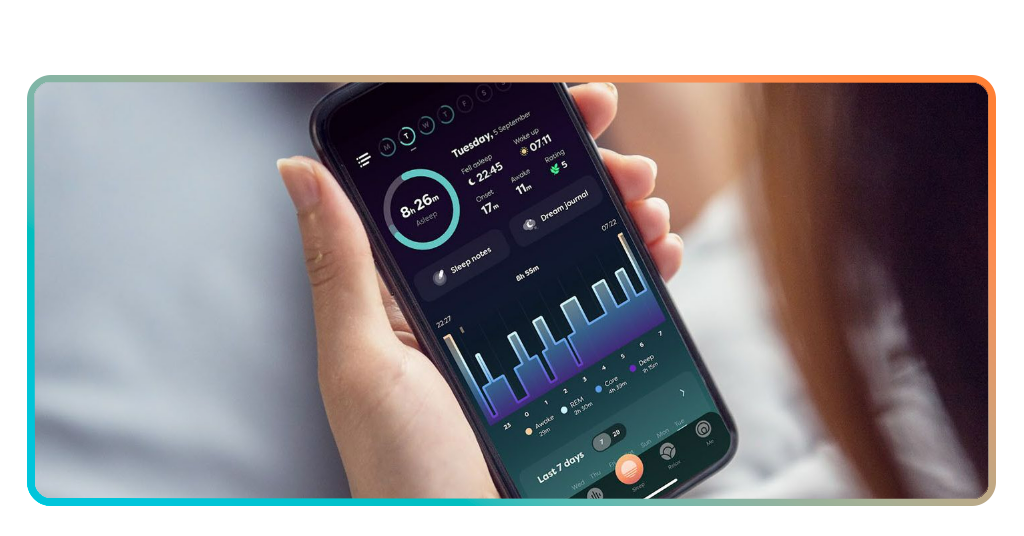
Apps like Sleep Cycle (Android | iOS) analyze overnight patterns and present them in clear charts.
You see how long you spent asleep, how often you woke up, and how consistent your schedule is across days. Over time, patterns emerge.
Tracking sleep consistently helps users identify behaviors that quietly sabotage rest, such as late caffeine intake, irregular bedtimes, or screen exposure before sleep.
Instead of guessing why you feel tired, you have evidence. That shift alone can change habits faster than generic advice ever could. A smart sleep tracker typically provides insights such as:
- Total sleep duration compared to your personal baseline;
- Sleep quality scores based on movement and interruptions;
- Trends across weeks, not just single nights;
- Bedtime consistency and its impact on mornings;
- Correlations between routines and rest quality.
Think about it: a data-driven approach replaces vague fatigue with concrete feedback.
4.7/5
Detecting snoring and coughing patterns during the night
One of the most downloaded features of any sleep tracker is also the most personal. Snoring detection.
Sleep Cycle uses your phone’s microphone to record short audio samples when it detects noise during the night. That includes snoring, coughing, or other disturbances.
The app, available for Android e iOS, does not record continuously, which helps with privacy and storage concerns.
For many users, this feature answers long-standing questions. Do you snore? How often? Does it spike on certain nights? Is alcohol involved? Is congestion playing a role?
Snoring is not just a social issue. The Sleep Foundation notes that chronic snoring can be a sign of disrupted breathing and fragmented sleep. Identifying patterns is often the first step toward improvement.
This feature also adds an element of accountability. It is harder to ignore a problem when you can hear it.
4.7/5
Waking up at the optimal moment in your sleep cycle
The signature feature of a sleep tracker is the smart alarm. Instead of a fixed alarm time, you set a window, usually 30 minutes. Within that range, the app looks for the lightest sleep phase and wakes you gently.
This approach is supported by sleep research. Waking during light sleep reduces sleep inertia and improves perceived alertness.
While no app can read brain waves without hardware, movement and sound provide surprisingly reliable proxies.
What makes this compelling is its probability. A smart sleep tracker increases the odds that you wake up at a better moment, day after day.
Over time, this compounds. Better mornings often lead to better routines, earlier bedtimes, and improved consistency. Sleep becomes a cycle that supports itself instead of fighting you.
Listening to soothing sounds to fall asleep faster
Falling asleep is its own challenge. Racing thoughts, background noise, and stress make it harder than it should be. Many sleep tracker apps include sound libraries designed to ease the transition into sleep.
Sleep Cycle offers ambient soundscapes, white noise, and guided audio designed to mask disruptive noise and encourage relaxation. These sounds can be set to fade out once you fall asleep, avoiding unnecessary stimulation.
A feature that is particularly useful for people who live in noisy environments or share spaces. Consistent auditory input reduces sudden sound changes, which are known to fragment sleep.
No hardware required, just your phone
While wearable sleep devices offer additional biometric data, they are not necessary for meaningful insights. For many users, simplicity leads to consistency.
If you are curious about hardware-based alternatives, this guide by Insiderbits explores smart headbands and other options.
For most people, though, a phone-based sleep tracker delivers more than enough value to start improving sleep quality immediately.
Final thoughts: why tracking sleep changes behavior
Awareness changes behavior.
Most people believe they know how well they sleep, yet research consistently shows a gap between perceived rest and actual sleep quality.
You no longer guess why you feel drained on a Tuesday morning; you can see it reflected in short sleep cycles, frequent wake-ups, or inconsistent bedtimes.
When you see the consequences of late nights or irregular schedules reflected in your data, habits become harder to rationalize away.
Another reason behavior shifts is feedback speed. Traditional health outcomes take weeks or months to notice. Sleep data responds overnight.
Adjusting bedtime routines, limiting alcohol, or improving bedroom conditions often produces measurable changes within days.
At last, a comparison of popular sleep trackers highlighted that users who reviewed their data weekly were significantly more likely to adjust bedtime routines and reduce sleep debt over time.
Sleep stops being an afterthought and becomes part of daily decision-making.