

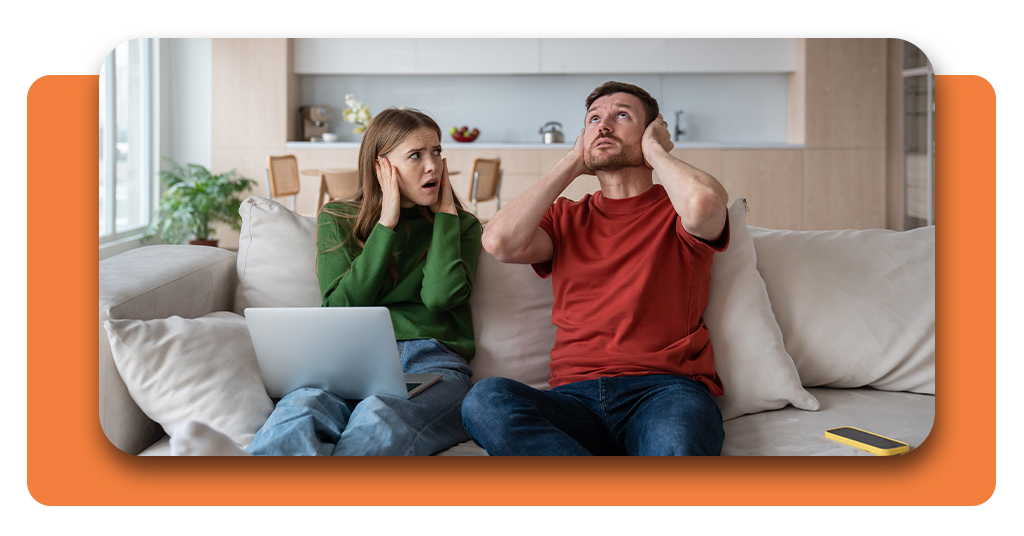
If you have ever tried to sleep while someone upstairs practices Olympic-level furniture dragging at 2 a.m., you already know this truth: noise is not a minor inconvenience. It is psychological erosion. Thin walls turn apartments into shared confessionals, where every stomp, bark, and bass drop becomes your problem. The rage is real, justified, and more common than property managers like to admit.
The issue is not sensitivity. Prolonged noise above 70 decibels can cause stress and fatigue, while levels over 85 decibels may lead to hearing damage over time. Yet when complaints reach landlords or HOAs, residents often hit the same wall they live behind: “Do you have proof?”. That is where measuring noise levels stops being petty and starts being tactical.
- Come il rumore bianco per i neonati può trasformare le routine del sonno
- Silent Travel: How Noise-Canceling Tech is Revolutionizing Trips
- Le 3 migliori app di rumore bianco per aiutare i bambini a dormire
Living in nightmare conditions due to thin walls
Modern housing favors efficiency over insulation. Lightweight construction materials transmit sound easily, especially low-frequency noise like footsteps, subwoofers, or slamming doors.
The result is a living environment where private life leaks through drywall.
Studies cited by the Environmental Protection Agency show that unwanted sound is one of the most reported quality-of-life issues in urban housing.
Complaining verbally rarely works because annoyance is subjective. What feels unbearable to you might be dismissed as “normal living noise” by a neighbor or property manager.
This imbalance keeps residents trapped in frustration loops. Measuring noise levels introduces an objective standard, shifting the conversation from emotion to evidence.
Gathering hard evidence with the measure noise levels app
Decibel X positions itself as more than a curiosity tool. It functions as a professional-grade sound level meter that uses your smartphone microphone to measure noise levels in real time.
The app displays minimum, maximum, and average decibel readings, allowing users to document exactly how loud an environment becomes during disturbances.
Unlike vague recordings, decibel data carries weight. When you can demonstrate that repeated noise spikes reach 90 decibels inside your apartment, the issue becomes quantifiable.
This matters because many local noise ordinances define violations numerically, not emotionally. Decibel X is available for both Android e iOS, making it accessible regardless of device ecosystem.
More details about how sound measurement apps work can be found in this Insiderbits guide on noise-canceling apps.

4.7/5
Creating a timestamped log to show your landlord
One complaint can be ignored. A pattern cannot. Decibel X allows users to log readings with timestamps, creating a timeline of repeated disturbances.
This transforms isolated incidents into documented behavior. Landlords, HOAs, and even municipal authorities respond differently when presented with organized data instead of angry emails.
A solid noise log should include:
- Date and time of the disturbance;
- Peak decibel reading captured by the app;
- Duration of the noise event;
- Notes describing the source, such as music, barking, or construction;
- Exported reports saved as PDFs or spreadsheets.
The export function is the app’s most strategic feature. It allows users to email reports directly or print them for in-person meetings.
According to Nolo’s legal overview of neighbor noise disputes, written documentation significantly strengthens tenant complaints, especially when escalation becomes necessary.
Understanding legal noise limits vs. annoyance
In the United States, noise regulation is anchored in the Noise Control Act of 1972, a federal law created in response to mounting evidence that unchecked sound pollution posed a real threat to public health, particularly in dense urban environments.
Congress formally recognized that excessive noise is not just disruptive, but harmful, citing sources such as transportation systems, machinery, household appliances, and commercial products as primary offenders.
The Act established a national policy aimed at protecting Americans from noise levels that jeopardize health and welfare.
While enforcement largely falls to state and local governments, federal oversight exists for a reason.
Certain noise sources require uniform national standards, especially products distributed across state lines.
This is why the Environmental Protection Agency stated emission standards for commercial products, and informed the public about measurable noise risks.
It’ll matter to you when confronting a noise dispute
Feeling disturbed does not automatically mean a violation has occurred. What carries legal weight is exceeding established decibel thresholds, especially during designated quiet hours.
Noise complaints become actionable when they align with measurable limits defined by local ordinances, which often draw guidance from federal research coordinated under the Noise Control Act.
In practical terms, this means data wins where feelings fail. You are not “overreacting”. You are responding to documented violations.
Check the full EPA’s Summary of the Noise Control Act on how municipalities retain authority to regulate environmental noise here.
4.7/5
Confronting the problem with data instead of emotion
Direct confrontation fueled by anger rarely ends well. Data-driven confrontation changes the dynamic.
Presenting charts, averages, and timestamps removes personal hostility from the exchange. It signals seriousness and preparedness.
When approaching a landlord, HOA, or neighbor, measured communication backed by numbers tends to achieve one of two outcomes: compliance or enforcement. Either the noise stops, or penalties follow.
Reducing environmental noise benefits not only comfort but long-term wellbeing, reinforcing why enforcement exists in the first place.
The ultimate payoff is peace of mind. Measuring noise levels gives residents control in situations where they previously felt powerless. Silence becomes attainable, not aspirational.