

That dreadful feeling you get when you open the power bill and see a number way higher than you budgeted for is exactly what electric bill assistance programs are meant to prevent.
LIHEAP is an official government aid program designed to keep the power on when money is tight, and this Insiderbits guide explains how it works and what you need to qualify. Read on!
Correlato: Stop Overpaying for Energy with Free Home Upgrades Today
Which is the best tool to find state electric bill assistance?
The Low Income Home Energy Assistance Program, or LIHEAP, pays a portion of eligible household energy bills using federal money in every state, tribe, and US territory each year.
Congress created this electric bill assistance program decades ago to keep heating and cooling costs from pushing families into financial crisis during extreme weather months.
Every state runs its own version of the program with different income limits, applications, and benefit amounts, which makes finding the right entry point essential for your household.
A federal search tool built for every state
The federal government maintains a single directory covering all fifty states plus tribal territories, built specifically so you’re not stuck guessing which local agency handles your region.
Unlike state websites that vary wildly in design and detail, this directory pulls consistent information into one format, listing the exact office assigned to your area.
Local offices ready to process your request
Community agencies and local social service departments serve as the gatekeepers, reviewing income documents and calculating the amount each qualifying household receives yearly.
These offices exist specifically for electric bill assistance and similar programs, staffed by people who process applications daily and understand the paperwork far better than a general hotline.
A hotline backup when the tool falls short
You can also call the National Energy Assistance Referral line at 1-866-674-6327 if your state page looks outdated, broken, or confusing enough to slow down an application.
Representatives answer eligibility questions directly and know which office handles your specific address, something a static webpage cannot replace during a stressful moment.
Step-by-step: how to apply for LIHEAP energy grants online
Filling out an online application sounds simple until you realize LIHEAP has no single universal form, because every state builds its own portal, rules, and specific paperwork requirements.
Knowing the right order to follow, starting with checking your eligibility and ending with proof of income, turns electric bill assistance into a manageable process for your household.
Each stage moves you closer to a decision, and skipping details or rushing through paperwork tends to slow your approval far more than taking time upfront to prepare.
Step 1: visit the official LIHEAP website
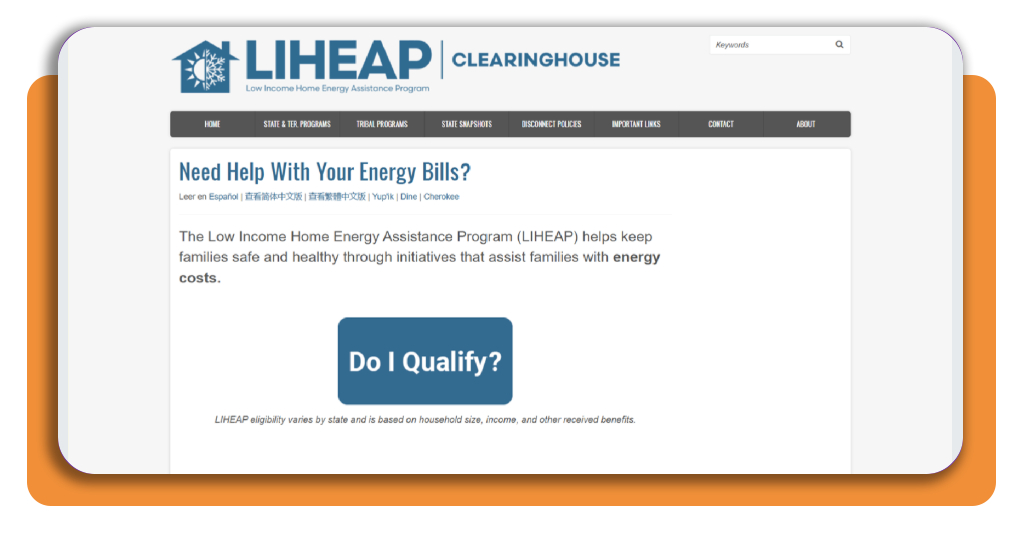
Head over to the LIHEAP Clearinghouse homepage, which is the federal page built to connect your household with local energy assistance offices across the country.
You’ll spot a big ‘Do I Qualify?’ button right at the center of the screen. Scrolling a bit further will also show you a call number, an email address, and a search tool for your state office.
Step 2: check your eligibility
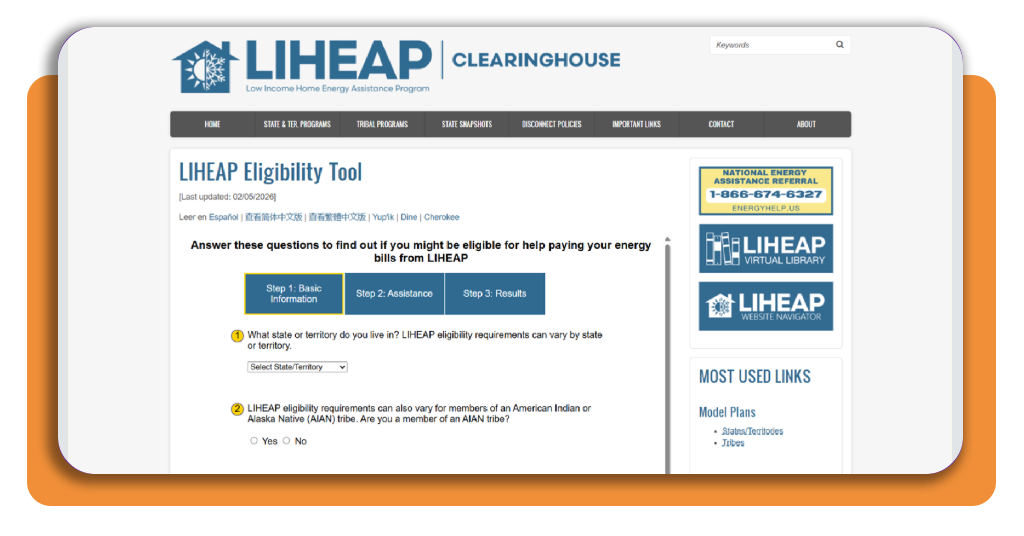
Open the LIHEAP eligibility tool and enter your state, household size, and income. The tool compares your numbers against your state’s current cutoff instantly.
Certain benefits you already receive, like SNAP or specific veteran programs, can qualify your household without any income calculation, saving you a step most applicants still complete.
Step 3: contact your local office
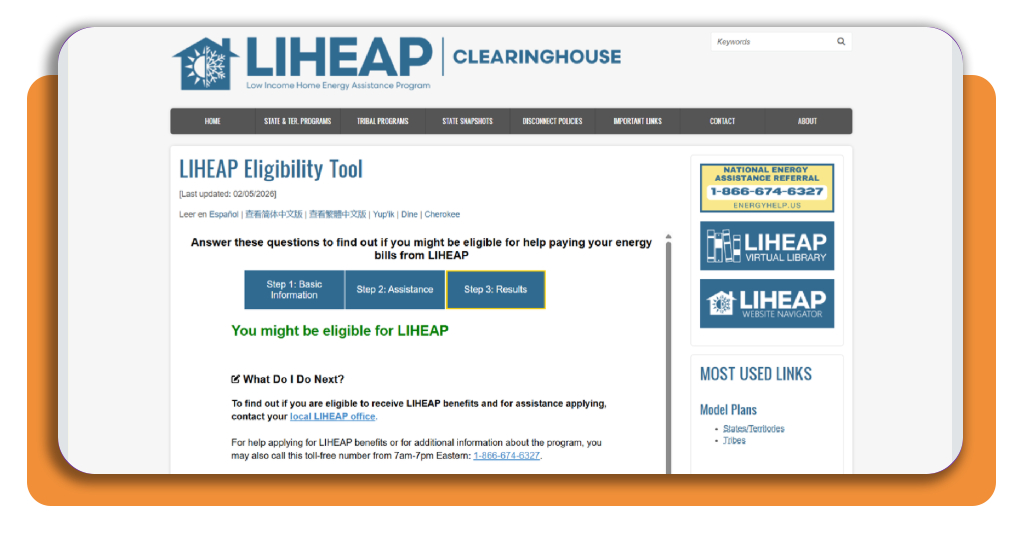
Once the eligibility tool shows you likely qualify, reach out to your local LIHEAP office directly to confirm your status and start your electric bill assistance application.
You can also call the toll-free hotline at 1-866-674-6327 between 7 am and 7 pm Eastern for help applying or answers about the program.
Step 4: submit your application to your state
Once you gather the required documents, you can send everything through your state’s chosen method, whether that means an online portal, a mailed packet, or a scheduled in-person visit.
Processing times vary by state and by how many households applied that season, so checking your application status with your local office beats sitting and waiting in silence.
Correlato: Assistance With Utility Bills: See How to Request it in Your County
Weatherization tips to lower your power bill
Small changes around your house often shave more off a power bill than a full renovation, especially once you stack several habits into one steady routine.
You don’t need thousands of dollars in upgrades to notice a difference. Plenty of these fixes cost very little and take minutes to set up around your home.
Programs that offer electric bill assistance help cover costs for months when bills spike, but pairing that support with smarter habits keeps your usage lower throughout the year.
Smart thermostats that learn your schedule
A smart thermostat tracks when you leave for work, when you return, and when you go to sleep, then adjusts the temperature on its own without daily input from you.
Setting your AC a few degrees higher while you’re out barely affects comfort once you walk back through the door, yet it trims real dollars off your cooling costs.
Small plugs that stop hidden energy waste
Devices plugged into outlets keep drawing power even when switched off, quietly stacking charges onto your bill that most people never catch until they check the numbers.
A smart plug lets you cut power to laptops, coffee makers, and other electronics with a single tap, closing the gap between what you actually use and what you pay.
Zoning and fans for smarter cooling
Cooling an entire house when you only occupy two rooms wastes energy. Separating your home into zones with individual thermostats keeps that cost contained to the space you use.
Running a ceiling fan alongside your AC moves cooled air more evenly through each room, letting you raise the thermostat while your space still feels just as comfortable.
Best budgeting tools to manage household expenses
A budgeting app won’t lower your power bill on its own, but it shows you exactly where your money goes each month, including every dollar spent on utilities.
Watching your spending in real time catches problems early, long before a missed payment turns into a shutoff notice or a scramble to cover a surprise charge.
Pairing a budgeting app with electric bill assistance gives you both sides of the equation, covering immediate costs while building habits that keep future bills under control.
YNAB
YNAB (Android | iOS) assigns every dollar you earn a specific job the moment it lands in your account, forcing you to plan spending instead of reacting to it after the fact.
You build custom categories for rent, groceries, and utilities, then watch your balance shift as you spend, giving you a live picture of where your money actually goes.
Monarch Money
Monarch Money (Android | iOS) pulls every account you own into one dashboard, showing your bank balances, credit cards, and investments so you don’t need to check separate apps.
The app also tracks recurring bills automatically, flagging your electric bill assistance payments alongside rent and subscriptions so nothing slips through unnoticed at the end of the month.
PocketGuard
PocketGuard (Android | iOS) calculates a single number after your bills, savings goals, and essentials, showing what’s left for you to spend without touching money already spoken for.
That number updates as new charges hit your account, giving you a constant gut check before you swipe a card on something outside your planned monthly budget.
Correlato: Social benefits app: find local programs available to you
Stack the savings, skip the stress
Covering a power bill sometimes meant skipping something else your household needed. That trade-off can stay in the past now that you know LIHEAP exists and how to qualify.
In this guide, we at Insiderbits showed you where to find electric bill assistance, how the application process works, and small habits that keep your monthly costs lower.
Read more Insiderbits articles to learn about how the US government can help you cover everyday costs, from rent and groceries to medical bills and other household expenses.