

Recruiters lock in enlistment dates and expect a qualifying score on the first attempt, which means a comprehensive ASVAB practice test becomes your best shot at walking in prepared.
This guide from Insiderbits covers the ASVAB Practice Test app, along with score requirements and finance tools built for military life, giving your prep the direction it needs. Keep reading!
Correlato: Military ID: how to apply for your document online

5/5
Which is the best ASVAB practice test app?
Joining the military starts with passing an exam covering math, mechanics, and word knowledge, and the ASVAB Practice Test (Android | iOS) gives you a run at that challenge.
This app breaks every ASVAB subtest into focused practice sets, so you build real skill in each subject and gain steady momentum toward your target score.
The question bank spans thousands of scenarios pulled from real exam patterns, helping you recognize formats and question styles the moment you sit down for the actual test.
Features available in the ASVAB Practice Test 2026 app
- Extensive question bank: access thousands of ASVAB-style questions across nine subject areas, covering topics from mechanical comprehension through general science;
- Realistic test simulations: practice under timed conditions that mirror the actual exam format and difficulty, helping you build stamina before your enlistment test arrives;
- Offline access: study anywhere without needing an internet connection, keeping every question, explanation, and full practice set available whenever you find time to review;
- Quick Math training: Sharpen mental calculation skills with shortcuts and estimation techniques designed for a test that never allows you to use a calculator.
Track weak areas with smart analytics
Every question you answer inside the ASVAB Practice Test feeds into a performance dashboard that highlights exactly where you’re losing points, so weak subjects stop hiding until exam day.
The app builds a passing probability score based on your results, giving you a clear number to chase and real motivation to keep pushing your practice sessions forward.
Get instant help from an AI tutor
The app offers a personal AI tutor called ‘Mentora’ who’s always available, explaining every wrong answer in a way that’s easy to understand the moment you tap the screen for help.
Stuck on a tricky mechanical comprehension question? You can ask detailed follow-up questions and get guided hints that walk you through the full reasoning piece by piece.
Step-by-step: how to study for the military exam online
Studying for your enlistment exam no longer means lugging a thick prep book everywhere, because the ASVAB Practice Test (Android | iOS) puts every topic right on your phone for free.
The app offers a user-friendly interface, and a short setup walks you through your current knowledge level before unlocking the full question bank waiting to boost momentum.
From there, going digital lets you squeeze in a lesson during your lunch break or a long commute, fitting real practice into an already packed weekly schedule.
Passo 1: scarica l'app sul tuo dispositivo
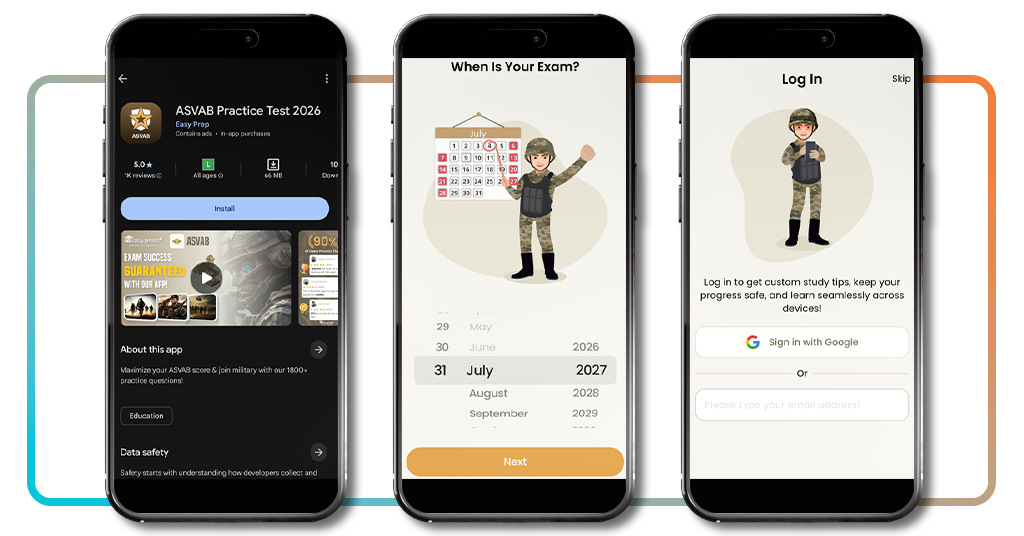
You’ll find the app listed on Google Play e il App Store, letting you install it on Android or iPhone within a handful of spare minutes and without having to pay for a subscription.
Once it’s installed, open the app and select your exam day before moving forward. You can also create an account at this stage, but having an account is not mandatory.
Step 2: take the diagnostic test
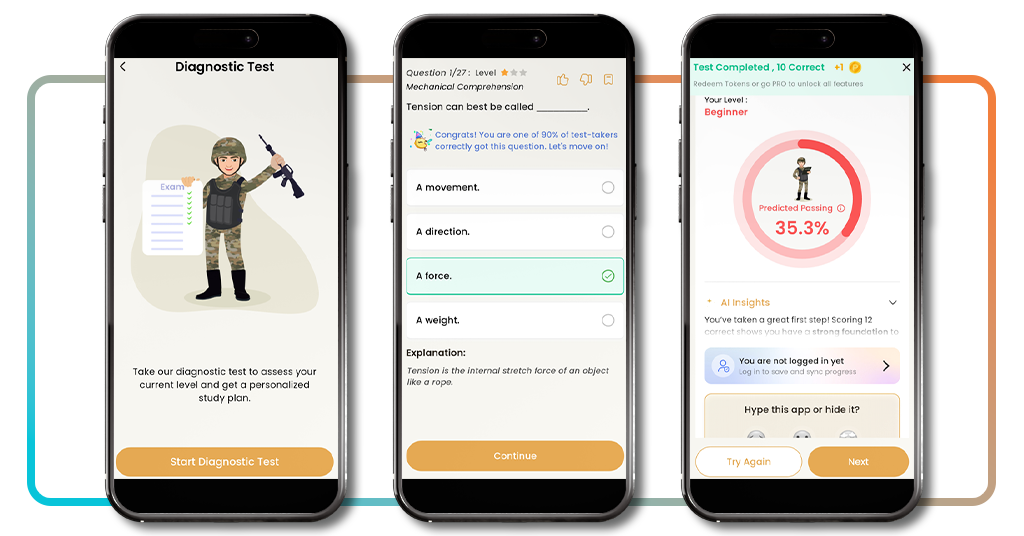
The diagnostic test in the ASVAB Practice Test asks a set of questions styled after the official format, covering topics like mechanical comprehension and word knowledge.
Each question shows its difficulty level and a short explanation once you answer, helping you grasp the reasoning behind every correct response before moving to the next one.
Step 3: follow your personalized study plan
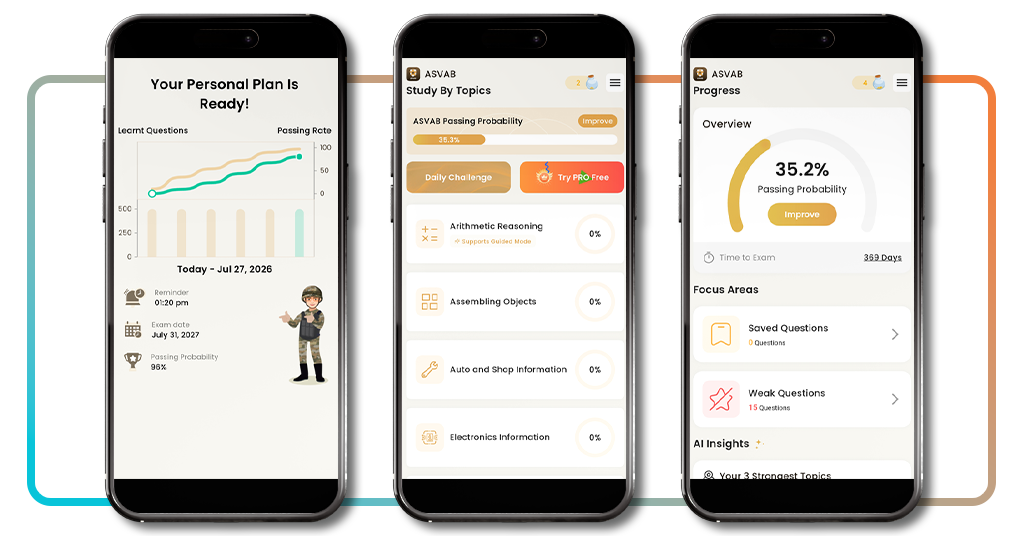
Once your diagnostic results come in, the plan lines up daily lessons around your trouble spots, offering a passing probability score you can watch grow with each session.
The main dashboard lays out every topic area with its own progress circle, letting you jump directly into whichever one needs your attention before starting your next lesson.
Correlato: Request your military records online: learn how using this guide
Understanding ASVAB scores: what jobs can you qualify for?
Your enlistment exam produces a raw score converted into a percentile called the AFQT, and that single number decides whether you even qualify to join a branch.
Beyond that overall percentile, the exam divides into 10 separate line scores, and the ASVAB Practice Test app helps you understand what each category measures before test day.
Recruiters use those line scores to match you with a specific job, so understanding this system now saves you from confusion during your enlistment paperwork later on.
Decode your AFQT and line scores
Your AFQT comes from combining scores in word knowledge, paragraph comprehension, arithmetic reasoning, and math, and the military uses that number as your basic qualifying gate.
Line scores work differently, blending different subject combinations into categories like clerical, combat, and electronics, each one built to predict success in a distinct group of jobs.
Match your scores to Army jobs
Every Army job carries its own minimum line score requirement, and hitting that threshold opens the door to apply for a role you’ve had your eye on.
An infantry position calls for a combat score of at least 87, while a cardiovascular specialist role needs a surveillance and technical score above 101 to qualify.
Set a target score for your job
Once you know which job you’re interested in, work backward from its required line score and treat that number as the goal driving every study session going forward.
Building consistent habits with the ASVAB Practice Test app gives you a clear way to track progress toward that target, turning an abstract score requirement into a reachable milestone.
Best financial planning tools for US military
Landing a job through your enlistment score marks a huge milestone, but managing pay, deployments, and frequent moves calls for its own kind of preparation entirely.
Military life brings unique financial challenges most civilian budgeting advice never addresses, and building smart habits now works the same way studying with the ASVAB Practice Test does.
Several organizations built their entire mission around supporting military households, offering free guidance that takes the guesswork out of budgeting, saving, and planning for retirement.
Free financial counseling from Military OneSource
Service members get unlimited access to accredited financial counselors through Military OneSource, meeting online, by phone, or in person whenever money questions come up.
These counselors help you evaluate accounts, negotiate with creditors, and build a workable budget, giving you expert guidance without the cost of hiring a private advisor.
FINRED calculators for savings and retirement
The Department of Defense runs FINRED, a site packed with calculator tools covering savings goals, loan payoff timelines, and long-term retirement planning built around military pay.
Their Retirement Nest Egg Calculator helps you figure out exactly how much you need to save, turning a vague future goal into a concrete monthly number.
Nonprofit resources built for troops
Organizations like AAFMAA e MOAA offer learning hubs packed with articles, tools, and guidance built around the financial realities of military families and their unique needs.
Pairing these resources with steady study habits, the kind you already built while working through the ASVAB Practice Test, sets you up for lasting financial confidence.
Correlato: Military enlistment bonus: how to earn up to $50,000 when serving
Top online resources to boost your math and word knowledge skills
Two subjects are determinant on your enlistment exam, and strengthening arithmetic reasoning alongside word knowledge pays off across nearly every other section of the test.
Free platforms built by educators can fill in gaps that a single study app might miss, giving you extra practice built around real classroom teaching methods and pacing.
Pairing these outside resources with steady sessions on the ASVAB Practice Test app rounds out your prep, covering both foundational skills and exam-specific question formats at once.
Khan Academy
Khan Academy offers free video lessons covering arithmetic, algebra, and geometry, breaking down each concept for anyone who needs a refresher before jumping into practice problems.
Working through their exercises rebuilds math fundamentals you might not have touched since high school, giving you a stronger foundation before tackling arithmetic reasoning questions.
BrainPOP
Short animated videos and quizzes cover vocabulary, reading comprehension, and science topics in bite-sized chunks, making review feel like a quick, fun refresher.
BrainPOP‘s format works well for word knowledge practice, introducing new vocabulary through context and visuals rather than forcing you to memorize long lists of isolated definitions.
Desmos
This free graphing calculator helps you visualize algebra and geometry problems, turning abstract equations into shapes and lines you can actually see and manipulate on screen.
Keep in mind your actual enlistment exam won’t allow calculators, so treat Desmos as a learning tool for building understanding rather than something you’ll use on test day.
5/5
Your path to a military career starts now
Picking up the ASVAB Practice Test app puts an actual structure behind your prep, turning your study sessions into a clear path toward the score you need on the exam.
In this guide, we showed you how the ASVAB Practice Test connects to score requirements, plus crucial military finance tools and resources that sharpen your overall knowledge skills.
Stay with Insiderbits and learn more ways to budget your military pay, compare other prep apps, and track down benefits worth claiming before you ship out.