

A family name in a census record can tell you who your ancestors were, but it doesn’t necessarily show where their lives unfolded. Seeing the exact property they owned or the land they received can transform a simple genealogy search into a much richer historical discovery. That is where historical land maps become valuable research tools.
HistoryGeo connects historical land records with interactive maps, making it possible to explore original ownership information through a visual interface. This way, every researcher can identify ancestral properties, follow migration patterns, and uncover geographic connections that might otherwise remain hidden for generations.
Where to search family’s property through historical maps?
With the platform Idées reçues will uncover below, it got way easier to find ancestral property records.
That’s all thanks to digital genealogy resources and historical mapping platforms.
Today, researchers can search land ownership information that once required visits to local archives and government offices.
HistoryGeo is a platform of historical map collections that allow users to explore original land ownership records and identify where early settlers and landowners acquired property.
Also, since government repositories preserve historical documents that help connect family names with specific locations, national and state archives can provide valuable information.
Alongside, genealogy websites, census records, probate documents, tax records, and family trees can help narrow the search before historical maps are used to verify property locations.
If you combine several sources, or search in official registers such as in the National Archives, you can produce the most accurate results.
This whole research works like an investigation, so a name found in a census record may lead to a county.
Then, it can then be matched with historical land maps to reveal where an ancestor actually lived or owned land.
Step-by-step: how to trace historical land maps using HistoryGeo
HistoryGeo is the platform created to simplify the process of connecting family names with historical land ownership records.
Check this guide below and make your research more visual and intuitive:
Step 1: create a HistoryGeo account
First of all, visit the HistoryGeo website and choose a subscription plan that matches your research needs.
Once registered, you can access the platform’s land ownership databases and mapping tools.
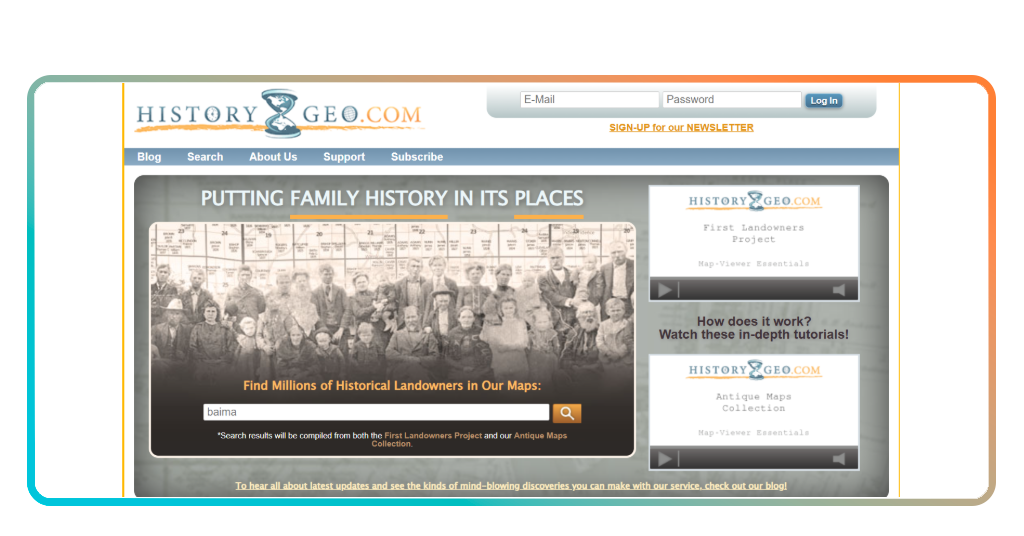
Step 2: search for an ancestor’s name
Then, enter a surname or full name into the search tool.
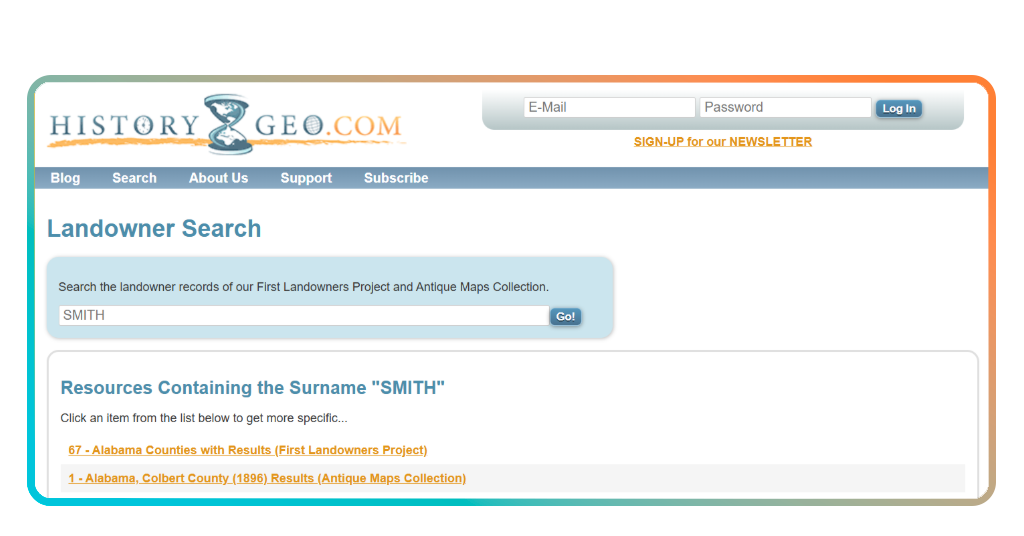
Step 3: explore the interactive maps
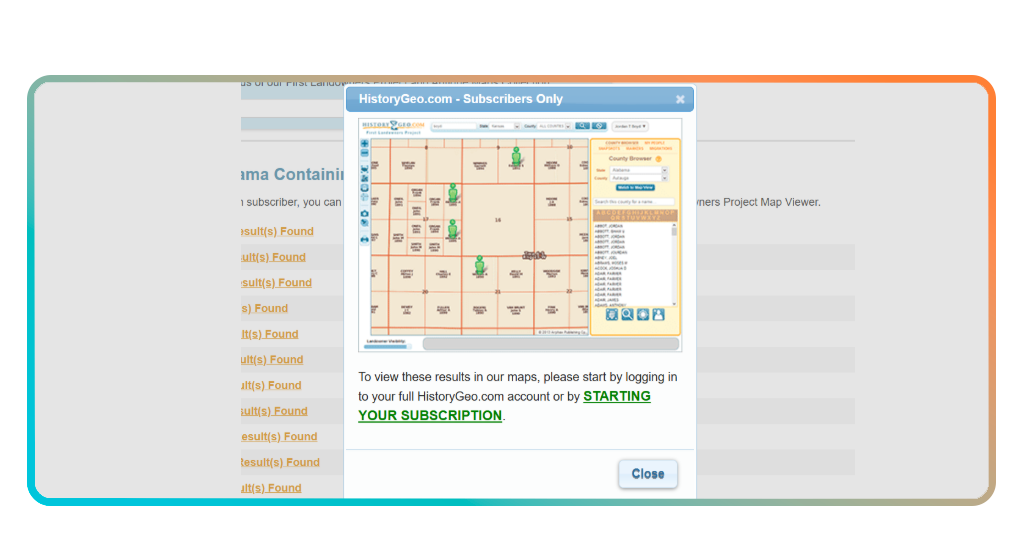
Open the mapped records to see where the property was located, but this feature is available for subscribers only.
This allows you to visualize land boundaries and understand how the property related to nearby towns, roads, and settlements.
Step 4: connect the findings with other genealogy records
Finally, compare the land information with census records, family trees, birth records, and other historical documents.
Tips for accurate genealogy research
As you just read, a successful genealogy research depends on verifying information through multiple sources.
That’s a good option because historical documents can contain spelling variations, and even incomplete information that may lead researchers in the wrong direction.
Those types of ‘errors’ happen frequently because it is normal for family names to be changed over time.
Because of that, when searching historical land maps, it is helpful to test alternative spellings and variations that may have appeared in older records.
Geographic context is equally important, so knowing the region where an ancestor lived improves search accuracy and distinguishes between people who share the same name.
Moreover, keeping recording sources, dates, locations, and document references makes it easier to revisit findings and verify information later.
Then, you’ll also need patience. Minor discoveries from census records, and historical land maps connect gradually revealing a complete picture of a family’s history.
Other ways to trace your heritage
We just showed you that historical land maps can reveal where ancestors lived, but they represent only one piece of a larger family history puzzle.
Therefore, if you can combine geographic records with other research methods in your investigation, it will lead to richer and detailed discoveries.
Census records, for instance, are among the most valuable resources available because they provide a lot of different information.
With the census record, we discover data about family members, occupations, ages, places of birth, and migration patterns across multiple generations.
Also, some services that offer family tree tools, historical records, and DNA matching may uncover relatives and documents that are difficult to find elsewhere.
Local archives, newspapers, church records, and cemetery databases frequently contain details that never appear in land ownership documents.
In the end, the best genealogy research combines different types of evidence.
Historical maps may show where a family lived, while census records and family documents tell the story of what life was actually like in that place.
Discover your family’s story through historical land records
Overall, historical land maps provide a unique way to connect names from old records with real places on the map.
HistoryGeo makes this process accessible by combining historical land records with interactive mapping technology.
If you have ever wondered where your family lived, farmed, or built their lives generations ago, historical land maps can be an excellent place to start.
A single property record may uncover locations, relatives, connections, and other family information that transform family history into a personal journey.
En rapport : Discover your roots with MyHeritage – join now
Cet article vous a plu ? Enregistrez-le Idées reçues Ajoutez-le à vos favoris et découvrez les astuces technologiques les plus utiles.