
In a world that moves at the speed of light (seven notifications per minute, deadlines that seem to travel faster than you do, and routines that feel more treadmill than journey) it’s easy to forget our place in the universe. We scroll through space memes, read updates about Mars rovers, watch rocket launches on mute during breakfast, yet very few of us actually experience the cosmos beyond flat images and recycled tweets.
What if you could touch a nebula? Orbit Jupiter’s Great Red Spot? Track Saturn’s rings from an angle no camera has captured? That’s the kind of awe most people assume requires a telescope, a travel budget rivaling NASA’s annual coffee bill, or sheer luck with clear skies. But thanks to modern space simulation tools, the universe is a space you can explore, zoom into, learn from, and come away changed.
- Meta Quest: Exploring the Depths of 3D Immersion
- Visitez les villes en détail avec cette carte 3D de la Terre
- Conquérir les rues en conduisant Real Race City 3D
Why space exploration still fascinates us
Humanity has looked skyward for as long as we’ve walked upright. Once upon a time, constellations were our calendars, agricultural guides, and mythic stage sets.
Today they’re data points, launch targets, and inspiration for engineers who design spacecraft capable of crossing millions of miles.
The psychology behind our cosmic obsession isn’t arbitrary: studies of human curiosity link awe — that feeling you get when confronted with something vast and incomprehensible — to improved analytical thinking and well-being.
In essence, looking outward helps us feel more connected inwardly.
American space culture plays a central role in this phenomenon.
NASA’s missions to Mars, the moon landings, the Hubble Space Telescope’s breathtaking deep-field images, and the ongoing James Webb Space Telescope discoveries all fuel both public curiosity and scientific literacy.
According to NASA, more people engage with space content, educational outreach and science events than with almost any single STEM field outside computer science or medicine.
But real space travel remains the realm of astronauts and billionaires. That’s where a space simulation app fills the gap, by giving you interactive tools that let you feel like an explorer without leaving your living room.
This space simulation app brings the universe to your hands
Entrer Champ d'application du système solaire, an immersive space simulation platform that turns your phone or tablet into a gateway to the cosmos.
At its core, this app uses real astronomy models to render planets, moons, asteroid belts and stars in detailed 3D.
A scientifically grounded representation built from astronomical data, visualized so you can investigate angles and dynamics that textbooks don’t show.
The developers explain their philosophy on their official site: Solar System Scope is rooted in scientific accuracy but designed for intuitive exploration.
Whether you’re a lifelong space nerd or someone who just realized that celestial bodies move, not just look pretty, this tool speaks your language.
Disponible pour Android et iOS, with it, you can zoom through the asteroid belt, shadow Jupiter’s moons, or watch Earth rotate in real time, all from your screen.
If your curiosity extends beyond planetary models — say, you want to track observatory events, meteor showers or space phenomena — complementing your spatial exploration with a space events calendar tool.

4.6/5
Travel through planets, stars and galaxies in realistic 3D
When you read that Jupiter’s diameter is 11 times that of Earth, your brain tries and fails to conceptualize it. Visualization changes that.
Vous see Jupiter next to Earth, you feel the comparative size of Saturn’s rings, and you witness the orbital dances of moons like Europa and Titan.
Solar System Scope interface lets you explore deep space structures, look into star clusters, and observe constellations with proper celestial positioning.
Unlike static atlas graphics, the 3D simulation accounts for real tilt, rotation, orbital eccentricity and relative distances, so your exploration reflects dynamics closer to reality.
In educational settings, this transforms abstract data into immersive learning.
For self-guided learners, it turns a confusing jumble of facts into a navigable adventure. For families, it offers shared stargazing without requiring a night under cold skies.
For adults who remember space from textbooks but never explored it interactively, it’s a revelation.
Learn astronomy with interactive, guided exploration
A space simulation app works as a learning engine. Solar System Scope includes informational overlays, interactive guides, and descriptions that help you understand not just what things are, but why they matter.
For instance, learning that Mars has the tallest volcano in the solar system becomes exponentially more impactful when you can align your view with Olympus Mons’ actual topography.
The platform’s SpacePedia provides context for each celestial body: orbital periods, composition, discovery history, and notable missions.
This layered approach mirrors effective pedagogical strategies used in formal astronomy education: visual context plus factual explanation equals retention.
And because the content is driven by real data, in part sourced from public astronomy databases, you can trust that what you’re learning is grounded in peer-reviewed research and accepted astronomical measurements.
You may be a student preparing for an astronomy class, a hobbyist who once memorized star patterns for fun, or someone who just wants to feel a little less tiny in a vast universe, the guided experience bridges curiosity with comprehension.
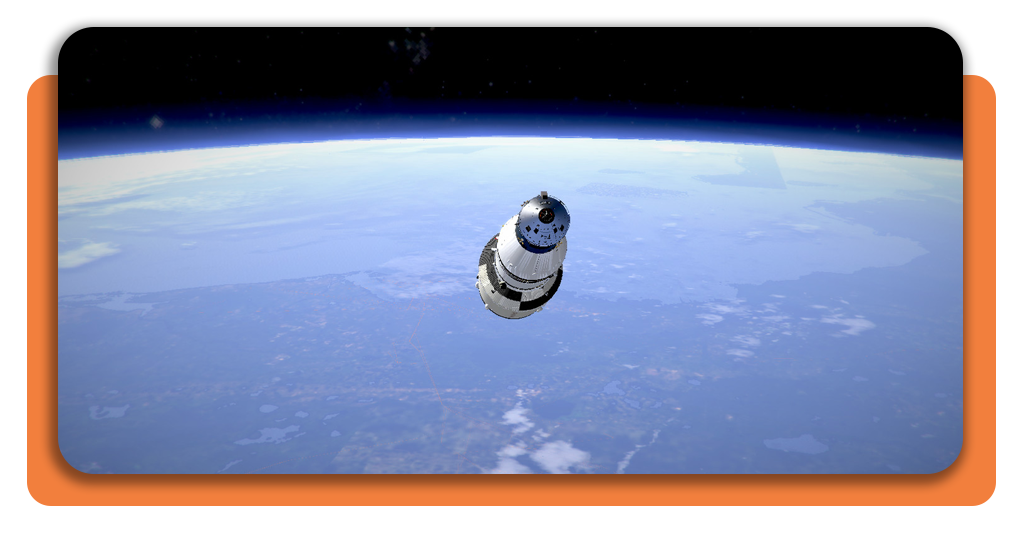
Feel the awe of experiencing space without a telescope
Telescopes are brilliant, until you remember they’re expensive, need clear skies, and sometimes demand technical know-how to use.
A space simulation app sidesteps all of that with accessibility and freedom. You don’t wait for perfect weather. You don’t interpret blurry shadows. You navigate cosmic landscapes at your pace, replaying or zooming to angles that observatories might never capture.
Astronomers often talk about the “overview effect”, the cognitive shift astronauts experience when seeing Earth from orbit. A similar, scaled version of that effect happens when everyday users interact with a faithful space simulation.
Suddenly, days feel smaller, distant worlds feel reachable, and your own life seems part of a bigger, more interconnected story.
4.6/5
Final thoughts: start your space journey now
A space simulation app transforms idle curiosity into meaningful engagement. It takes the overwhelming vastness of the universe and makes it navigable, interpretable, and frankly, exciting.
Exploration sometimes starts with a willingness to see, to question, to zoom out. This tool gives you that starting point. Discover the universe in minutes.
The universe isn’t waiting for you to get a telescope. It’s ready on your device. Explore planets and stars in 3D.