

Some smartphones don’t have a really nice sound originally from their devices. Still, this is relevant in the moment you need to listen to a voice call and there’s annoying noises from public transport, busy streets, shared rooms, or someone else listening to music in a public space. Firstly, this situation doesn’t bother you that much, yet if it repeats constantly, simple actions like answering a call become an exercise in irritation.
That recurring limitation is exactly why free audio utility solutions are attracting massive attention. When users look for immediate ways to push sound levels beyond default settings, without replacing hardware, a volume booster app shows up as a simple solution to a universal annoyance. Read on! Idées reçues will help you solve this problem with your device’s sound.
- How To Increase The Volume By 200%
- Comment personnaliser le bouton de volume sur Android
- Increase the Volume: Android vs. iOS – The Ultimate Guide
Looking for a free volume booster app?
If you have arrived here, you are probably feeling irritated with background noise that disturbs your peace, and now you’re looking for a free volume booster app.
No doubt you are dealing with noisy outside environments or shared spaces.
Maybe your issue is related to loud public transport, constant conversations, or people listening to music, leaving the impression that your device can’t respond to listening demands.
Since you are looking for a volume booster app, we can say this software-based solution is an alternative that attempts to extract stronger output from existing audio components.
Moreover, with this tool, your setup remains minimal. This volume booster app works right after installation and will start to fit naturally into your daily life.
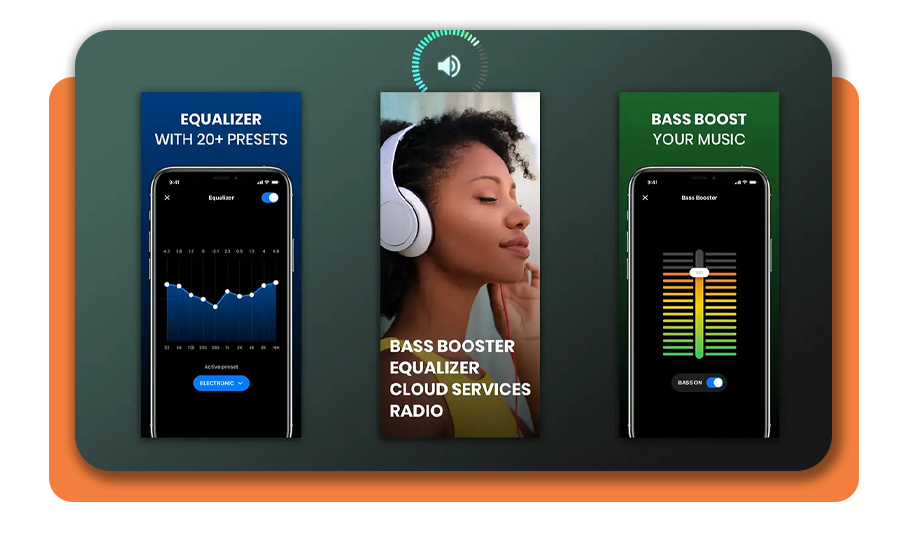
How to increase sound levels using Volume Booster – EQ Amplifier
To increase sound levels using Volume Booster – EQ Amplifier, you first need to understand that many phones stop short of their listening potential once the system volume reaches its ceiling constantly.
However, this volume booster app addresses that gap immediately, offering an amplified output that feels noticeable the moment audio starts playing.
When you have it installed, the app pushes sound beyond default limits and can reach up to a surprisingly high 200% boost, creating the sensation that the device is responding again to listening demands without requiring technical adjustments.
This is why the app resonates strongly among users of older smartphones or budget models, whose speakers tend to lose effectiveness over time or never delivered strong output in the first place.
In short, the Volume Booster app presents sound amplification as a quick corrective action, and not a long setup process, which explains why it continues to attract high-intent users looking to resolve audio limitations on the spot.

4.4/5
Features available in the Volume Booster – EQ Amplifier app
Some of the features available in the Volume Booster – EQ Amplifier app are designed around immediate volume increase.
Firstly, and as the main feature, we highlight the powerful bass booster. This booster, combined with the equalizer, can be really helpful for anyone looking to increase the music and calls experience on their phones.
With the integrated equalization adjustments, you can balance boosted output, and then prevent harsh peaks that could make louder sound uncomfortable.
This balance contributes to the perception that amplification serves practical listening needs, especially if you need to deal with noisy environments where clarity still matters alongside raw volume.
Do you need to pay to use Volume Booster – EQ Amplifier?
The first answer that comes as good news is: no. You don’t need to pay to use the volume booster app. You can find the app available for iOS devices, and download for free on the App Store.
Even though some people ask about payment when reading about the Bass Volume Booster, this question on payment usually comes up since the app delivers a noticeable boost and equalizer.
This free access covers the core function people seek, meaning louder audio during videos, equalization for music playback, or calls, without requiring immediate commitment.
That model works well for users who want to solve a specific problem in the moment and test the effect in real environments.
Treating sound amplification as a no-cost utility reinforces its role as a practical tool, and not as a premium and expensive feature.
For many users, this approach makes the app feel like a natural extension of the phone, restoring audibility whenever noise threatens to overpower the experience.
4.4/5
Tips for safe listening and device compatibility
Safe listening becomes even more relevant when you use sound amplification that pushes audio beyond default limits, changing how ears perceive pressure and fatigue over time.
That said, everyone who uses this volume booster app needs to take responsibility to treat higher levels as a temporary aid for noisy environments, and not as a constant setting during extended sessions.
In order to have a healthy hearing, a practical habit involves adjusting volume gradually and lowering it once background noise fades.
Also, short listening breaks also help reduce strain, especially when headphones are involved, where amplified sound reaches the ear directly rather than dispersing through speakers.
In addition, device compatibility plays a strong role in overall experience, as performance varies across smartphones depending on speaker design and operating system behavior.
Thankfully, Volume Booster – EQ Amplifier works across a wide range of devices and integrates smoothly with streaming platforms, calls, and media apps, although results may feel stronger on phones with well-maintained speakers.
Lastly, keeping the device system updated and avoiding extreme amplification on damaged speakers helps preserve sound quality.
With these small precautions above, a volume booster app can remain helpful without compromising comfort or device longevity during everyday use.
Volume Booster App: Make Your Phone Sound Louder Instantly – Conclusion
A volume booster app can be the answer for your frustration in daily life, when phone audio struggles to compete with surrounding noise and basic volume controls stop feeling effective.
What makes this type of solution resonate is the immediacy of the result, sending attention away from technical limitations and back to the content itself.
Exploring a volume booster app is a natural step for anyone who wants clearer audio in real environments. With the right expectations and mindful use, sound amplification turns into a simple adjustment that fits seamlessly into your routine.
En rapport : Les meilleures applications d'augmentation du volume pour les smartphones
Aimé cet article ? Enregistrez le Idées reçues favoris pour retrouver les derniers outils, les astuces de technologie créative et les innovations en matière de retouche photo.