
Most people generate valuable insights constantly while reading, studying, working, or moving through daily routines that stimulate thought. This explains that ideas rarely vanish due to lack of creativity or intelligence. The real issue appears when those ideas compete for attention inside an overloaded mind, which already manages different tasks throughout the day. In this environment, thoughts are postponed with the assumption they will resurface later, even though cognitive overload steadily weakens recall and turns promising insights into fleeting impressions that disappear without notice.
The second brain concept emerges as a response to this loss, proposing an external system that relieves the mind from the burden of retention and allows it to operate where it performs best. When thoughts are captured immediately and safely outside the mental workspace, creativity flows with less friction, projects gain continuity, and confidence replaces the anxiety of forgetting, transforming idea management into a supportive process, where remembering stops being a personal responsibility and becomes a reliable structure that sustains long-term thinking and organizes your mind effortlessly.
- AI-Powered Memory Boosters: Apps That Train Your Brain
- The Best Brain-Boosting Apps for Mind Improvement
- The attention economy: how apps rewire your brain
Why Your Best Ideas Disappear Before You Use Them
Ideas tend to surface at moments when attention is already divided, such as during reading, conversations, commuting, or transitions between tasks.
In these situations, the mind prioritizes continuity over capture, assuming that relevant thoughts will remain accessible once there is time to return to them.
This assumption rarely holds under cognitive pressure, with working memory degrading quickly when overloaded with competing inputs.
Also, as notifications, obligations, and unfinished tasks accumulate, even meaningful ideas lose clarity and dissolve before they can be transformed into something useful.
The disappearance of ideas does not indicate disorganization or lack of discipline. When the brain is forced to act simultaneously as creator, processor, and storage system, retention becomes the first function to fail.
However, a wise use of a second brain reduces this loss through externalization, allowing thoughts to be captured the moment they arise and removed from mental circulation.
Once ideas exist outside the mind in a reliable system, attention shifts away from remembering and toward developing, refining, and applying what was captured.
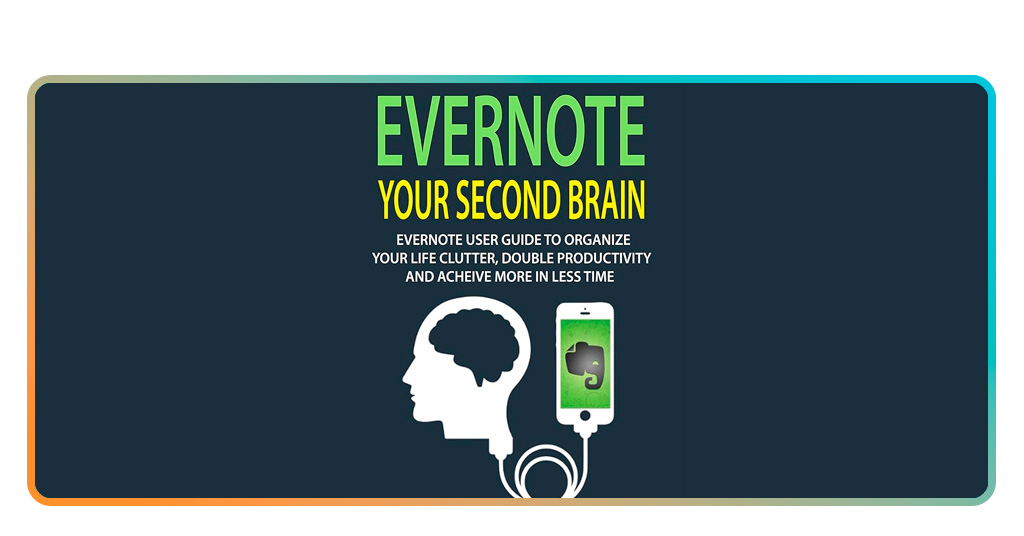
How a Second Brain App Organizes Notes Automatically
A second brain app organizes information without demanding structure at the moment of capture, removing hesitation and allowing ideas to be saved exactly as they appear.
The app Evernote (iOS/Android) is capable of absorbing notes, documents, images, and links into a single environment where organization emerges progressively instead of relying on rigid folders created in advance.
Consequently, as content accumulates, the system begins to reflect personal patterns of thinking rather than forcing artificial categories.
Meanwhile, automatic synchronization keeps every note accessible across devices, building trust that nothing will be lost or stranded in one place.
When access remains consistent, the mind releases the need to remember where information was stored.
In addition, search tools based on text recognition and contextual relevance replace manual sorting as the primary retrieval method.
In summary, this is how a second brain app organizes notes and becomes effective once ideas are found through meaning instead of perfect recall.

4/5
Best Functions for Creativity, Projects, and Daily Capture
One of the best functions of a second brain is how creative work benefits from capture tools that operate without friction.
For instance, when ideas are recorded the instant they surface, momentum is preserved and creative thinking continues without interruption or self-censorship.
Therefore, projects gain clarity when related thoughts and materials accumulate within a single environment that maintains context over time.
As information gathers organically, connections are visible and progress feels continuous.
All of this happens while daily capture plays a critical role in sustaining this system, as small notes, reminders, and observations reinforce the habit of externalizing memory instead of relying on recall.
Later, this combination supports a stable creative rhythm, where ideas move fluidly from capture to refinement and application.
A second brain works best when creativity flows forward without the pressure to remember everything at once.
Tips to Save Ideas Across All Devices
The first thing you need to know is saving ideas consistently depends on access, this matters more than discipline because thoughts emerge in different contexts that rarely align with a single device or location.
When capture tools remain available everywhere, the act of recording ideas feels natural and immediate instead of forced or postponed.
Also, cross-device synchronization ensures that ideas follow the user. Notes created on a phone during a commute remain accessible later on a computer, preserving continuity and prevents fragmentation across platforms.
This seamless availability reduces anxiety around forgetting, as the system proves reliable through repeated use. When trust is established, the mind stops rehearsing information internally and releases it without resistance.
In the end, a second brain gains strength when capture remains consistent across environments, leading ideas to survive longer once the system adapts to daily movement instead of demanding behavioral changes.
Build Your Second Brain Today
Building a second brain starts with a simple change in behavior, where thoughts are captured without hesitation instead of being mentally postponed.
This first step removes pressure from the mind and establishes a reliable place where ideas can exist safely outside short-term memory.
Then, consistency develops as capture turns into a reflex. When ideas are saved the moment they appear, the system grows naturally and reflects real thinking patterns instead of forced organization rules.
Over time, structure emerges from accumulation, as related notes connect through search and context rather than manual sorting. A second brain strengthens through use, gaining clarity as content expands and retrieval becomes intuitive.
Starting today means allowing the system to evolve alongside daily life. Once the mind trusts that nothing valuable will be lost, creativity and focus regain space to move forward, and you start to organize your mind effortlessly.
4/5
Never Lose Ideas Again: Build a Second Brain With This App – Conclusion
Building a reliable second brain changes how ideas are treated, with thoughts no longer depend on memory strength or perfect timing to survive beyond the moment they appear.
The app Evernote supports this shift through a system that absorbs information naturally, keeps it accessible across devices, and retrieves it through meaning rather than rigid structure.
Overall, a second brain works best when it becomes invisible, supporting thinking without demanding attention or discipline.
Related: Best Notion templates to organize your life in 2025
Enjoyed this article? Save the Insiderbits blog to your favorites for the latest tools, creative tech tips, and photo editing breakthroughs.