

It’s true that no one really likes counting the grams of fiber in a head of broccoli at 7:00 PM on a Tuesday. But if you’ve recently started a nutritional journey, you know that “eyeballing it” will only get you so far. At this point, a low carb diet app goes from being a digital luxury to a tool for survival. If you try to stay in ketosis without any help from technology, it’s like walking through a minefield in the dark.
You might make it through, but it will be a lot of trouble. The way food is made today is meant to make you fail. There are a lot of things that are bad for your metabolism, like “healthy” yogurt that has more sugar than a candy bar and “keto” bread that is really just a starch bomb in disguise.
- My Macros+: Your Personal Diet Assistant
- The Best Diet Apps To Plan Right Now
- The Rise of Plant-Based Diets: Top Vegan Apps to Guide Your Journey
Carb Manager: best carb diet app
If the world of nutritional tracking has a “final boss”, it’s Carb Manager. While other platforms try to track your sleep or remind you to breathe, this low carb diet app focuses on one thing: the macro.
It doesn’t care if you ran five miles if you came home and accidentally ate 150g of “hidden” carbs in a balsamic glaze. Carb Manager understands the modern human: we are lazy, busy, and want answers in three seconds.
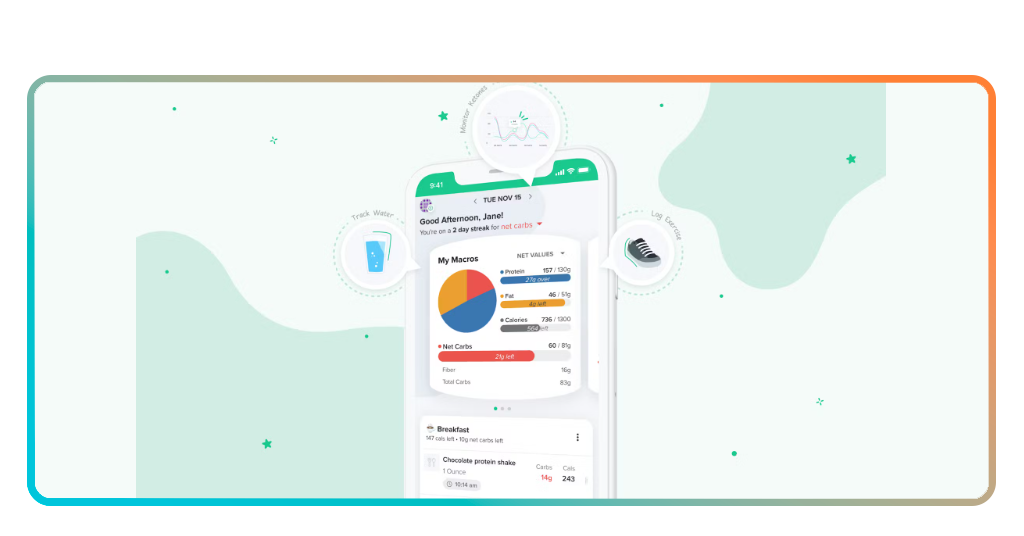
This low carb diet app features a database of over five million foods, so you aren’t manually typing in “avocado” for the tenth time today.
Features Available in the App
Think beyond the database: this low carb diet app has tools that make the lifestyle sustainable:
- The barcode scanner: you scan the back of a package, and the app instantly populates the macros. If it’s not in the database, you can add it in seconds;
- Image recognition (Snap Foods): you can literally take a photo of your plate, and the AI attempts to log the ingredients. It’s not 100% perfect yet (AI still struggles with “mystery sauces”), but it’s a massive time-saver;
- Macro customization: not everyone is doing 20g of carbs a day. Whether you are doing lazy keto, Paleo, or a high-protein/low-carb split, the app adjusts your targets accordingly;
- Integration: it talks to your Apple Watch, Fitbit, or Garmin, ensuring that your activity levels and intake are viewed in the same ecosystem.
Step-by-step: how to download and track your daily intake
Starting with a low carb diet app is easy; sticking with it is the part where most people stumble. Here’s how to set it up so that you can use it:
Step 1: install
Head to the App Store or Google Play and grab the Carb Manager app.
Step 2: onboarding interrogation
The app will ask for your height, weight, age, and activity level. Be honest. If you work a desk job, don’t tell the app you are “highly active” just because you walk to the breakroom twice a day.
Step 3: set your macro ratios
Where you define your version of a “low carb” lifestyle. The low carb diet app will suggest a default (usually 5% carbs, 25% protein, 70% fat for Keto), but you can slide those bars to fit your specific goals.
Step 4: the pre-log strategy
Log your breakfast and lunch before you eat them. If you log your dinner after you’ve already cleared the plate, the low carb diet app is just a digital diary of your mistakes. If you log it before, a roadmap for your success.
Step 5: review the weekly trends
Don’t obsess over a single day. Use the app’s reporting tools to see your weekly averages. This is where you’ll spot the “weekend creep” where those extra carbs start sneaking back in.

4.8/5
Other tools to keep track of your diet
While a dedicated low carb diet app like Carb Manager is the powerhouse, it shouldn’t be the only tool in your digital shed. The best results come from a multi-pronged approach to data:
- Smart kitchen scales: you can buy scales that sync via Bluetooth directly to your low carb diet app. If you are serious about precision—especially with calorie-dense foods like nuts or cheese—weight is always more accurate than volume;
- Blood ketone monitors: for those taking the “keto” route, devices like Keto-Mojo provide the physiological proof that your low carb diet app is working. It’s the difference between “I think I’m in ketosis” and “I know I am”;
- Specialized content platforms: if you find yourself getting bored with the same three meals, check out one of the best diet apps for broader recipe inspiration that still fits your macro goals.
- Digital fasting timers: often, a low-carb lifestyle is paired with intermittent fasting. Apps like Zero or Simple can help you track your eating windows, which works in tandem with your macro tracking to maximize metabolic flexibility.
How to keep a balanced diet on the long run
Truth may hurt, but still: a low carb diet app is just software; it cannot stop you from ordering a pizza at 11:00 PM. The long-term success of any nutritional shift depends on your ability to move from “tracking” to “understanding”.
The goal of using a low carb diet app is that, for example, after three months of scanning every label, you will naturally start to recognize that a medium apple has 20 grams of sugar and a serving of pasta is essentially a bowl of glucose.
To survive in the long run, you have to allow for the “80/20” rule. If you try to be 100% perfect 100% of the time, you will eventually delete the low carb diet app in a fit of rage and eat a loaf of bread.
Instead, use the app to maintain a high level of awareness during the week so that you have the metabolic “budget” for a social life on the weekend. Also, you need to understand that “low carb” doesn’t automatically mean “Healthy”.
You can eat bacon and processed cheese all day and stay under your carb limit, but your heart and skin will eventually send you a very angry letter.
Use the Everyday Health guide to low-carb diets to ensure you are prioritizing whole foods over “low-carb” processed junk. The app tracks the numbers, but you have to choose the quality.
4.8/5
Data over drama
Weight loss and health are often treated like emotional dramas, filled with guilt, “cheat days”, and self-loathing. But when you use a low carb diet app, you turn the drama into data.
It’s hard to feel guilty when you’re looking at a spreadsheet that tells you exactly why you didn’t lose weight this week (spoiler: it was the “keto” brownies).
Stop guessing, stop hoping, and start tracking. We at Insiderbits have found that the quickest way to get your habits back under control is to take away the mystery.
The numbers don’t lie—even when we try to lie to ourselves.